2027 Oscars Short Film Contenders: ‘Sulaimani’ Director Vinnie Ann Bose
Stay informed with free updates
Sign up to get our news digest — delivered directly to your inbox twice a week.
Welcome to Cartoon Brew’s series of spotlights focusing on the animated shorts that have qualified for the 2027 Oscars. The films in this series have qualified through one of multiple routes: by winning an Oscar-qualifying award at a film festival, by exhibiting theatrically, or by winning a Student Academy Award.
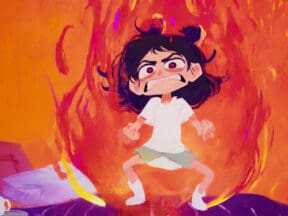
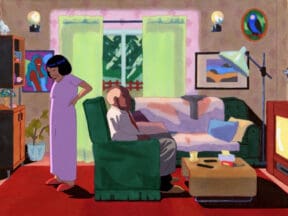
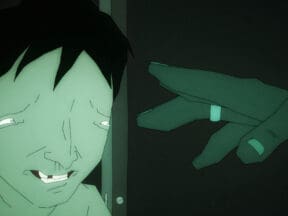
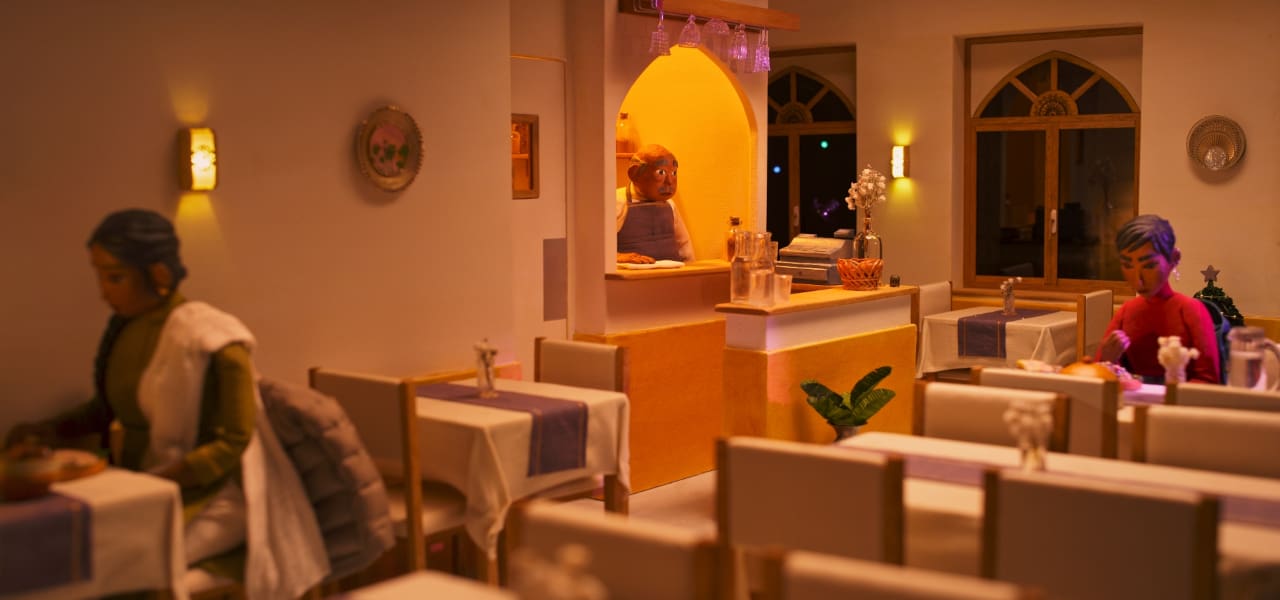
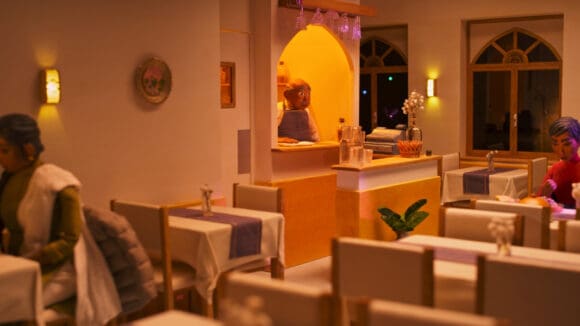
Today’s short is Vinnie Ann Bose’s Sulaimani, a French production from Girelle Production and Les Astronautes. Bose’s first professional film combines stop-motion for its present-day scenes with hand-painted 2D animation for memories. It earned Oscar qualification through wins for Best Short Film at the 2025 Manchester Animation Festival and the animation jury award at the 2026 Aspen Shortsfest.
At an Indian restaurant in Paris, two women from Kerala encounter familiar flavors, sounds, and smells that stir memories of the country they left behind. Their reasons for leaving differ, as do their relationships with home. Drawing on Bose’s own experience moving to France, Sulaimani explores food as both a source of comfort and a connection to complicated histories of family, identity, and independence.
Cartoon Brew: What was it about this story or concept that connected with you and compelled you to direct the film?

Vinnie Ann Bose: I am from Kerala, just like the two protagonists of the film. I moved to France in 2016 to study, and I started writing Sulaimani in 2018. It was a time when I was feeling very homesick. During difficult days, food from home was a big source of comfort. Sulaimani began with a simple craving for a Kerala restaurant in France.
Meanwhile, I was slowly starting to feel comfortable in France, which made me question my identity and my relationship with both countries. Sulaimani was a way for me to think through these questions and find some clarity in my life choices.
What did you learn through the experience of making this film, either production-wise, filmmaking-wise, creatively, or about the subject matter?
Sulaimani is my first professional film. The production was a wonderful experience, where I learned how to direct a team, collaborate with numerous talented artists to improve the film, and experiment with techniques that I had never tried before.
But the most valuable lesson was how to find the right distance when the film’s subject is so personal. This was the biggest challenge during the script and storyboard phase, creating an emotional roller coaster until I was satisfied with the animatic. Everything that followed seemed like a walk in the park in comparison.
Can you describe how you developed your visual approach to the film? Why did you settle on this style and technique?
I wanted to use two animation techniques to distinguish the present from the past. Stop-motion feels tangible and realistic, which I felt suited the present. I believe that memories are often shaped by our emotions rather than by facts. So I felt that 2D animation, with its hand-painted images and exaggerated colors, would help retain a certain imperfection and ambiguity, just like our memories.
I wanted the characters to have subtle and natural acting, so I decided on a realistic animation style. The character design was developed accordingly, to allow subtle expressions while remaining recognizable across both animation styles.
Food plays such an important role in the film. What were the biggest challenges in bringing its textures, preparation, and sensory qualities to the screen?
It was important to me to make the food look edible and delicious, even in miniature, as it is the heart of the film. But it was very tricky to make the food look appetizing!
We used the weirdest things, like hair gel with tiny pearls to create boiling water, plastic wrap to simulate tea being poured into a glass, papier-mâché to make the porottas, and glycerin to make the chicken curry shine. It took a lot of trial and error before we reached a satisfying result.