.png)
What Tex Avery And Frank Zappa Both Knew About Making Great Entertainment
Stay informed with free updates
Sign up to get our news digest — delivered directly to your inbox twice a week.
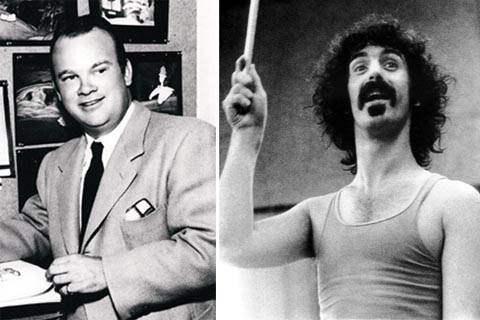
Want to understand why entertaining cartoons are all but impossible to produce nowadays? You can have the answer in just two short minutes by watching the first part of this interview with Frank Zappa. Though Zappa is explaining the decline of the music business, everything he says is applicable to the animation world as well.
I made a transcript for my own reference. Here is what Frank says:
“One thing that did happen during the Sixties was some music of an unusual or experimental nature did get recorded or did get released. Now look at who the executives were in those companies at those times. Not hip young guys. These were cigar-chomping old guys who looked at the product that came and said, ‘I don’t know. Who knows what it is. Record it. Stick it out. If it sells, alright.’ We were better off with those guys than we are now with the supposedly hip young executives who are making the decisions of what people should see and hear in the marketplace. The young guys are more conservative and more dangerous to the art form than the old guys with the cigars ever were. …Next thing you know [the hip young executive has] got his feet on the desk and he’s saying, ‘Well we can’t take a chance on this because that’s not what the kids really want and I know.’ And they got that attitude. And the day you get rid of that attitude and get back to ‘Who knows. Take a chance.’ That entrepreneurial spirit where even if you don’t like or understand what the record is that’s coming in the door, the person who is in the executive chair may not be the final arbiter of taste of the entire population.”
His ideas about how old-school execs were better for the music industry than younger “hip” execs mirror my own ideas about why the animation industry’s output nowadays is creatively spineless and lacking in point of view. Back in 2005, I wrote a piece called “Animation’s Greatest Executives” in which I sung the praises of the Golden Age animation execs like Leon Schlesinger, Eddie Selzer and Fred Quimby. These guys don’t receive much praise in history books, but it’s no accident that the most entertaining industry cartoons were produced under their watch.
In that earlier post, I offered the following quote in which director Tex Avery discussed his relationship with executive Leon Schlesinger at Warners:
“We worked every night – [Chuck] Jones, [Bob] Clampett, and I were all young and full of ambition. My gosh, nothing stopped us! We encouraged each other, and we really had a good ball rolling. I guess Schlesinger saw the light; he said, ‘Well, I’ll take you boys away from the main plant.’ He put us in our own little shack over on the [Warner Bros.] Sunset lot, completely separated from the Schlesinger studio, in some old dressing room or toilet or something, a little cottage sort of thing. We called it Termite Terrace. And he was smart; he didn’t disturb us. We were all alone out there, and he knew nothing of what went on.”
It should come as little surprise that Avery’s endorsement of Schlesinger so closely mirrors Zappa’s praise for the “cigar-chomping old” music execs. Leaving great artists alone to create great work is common sense. Execs in animation’s earlier days understood their roles; they provided the money and then they stepped back. It was their job to facilitate an environment where cartoons could be created most efficiently, not to dictate the content of the animation.
Today, execs want to noodle with every aspect of the process, even those aspects about which they are often clueless like entertainment and humor. They have gone so far as to give themselves oxymoronic job titles like “creative exec” and “development exec” to justify their interference in the creative process. There are obviously rare exceptions when a quality cartoon makes it to air, but look at the history of those projects and in most cases, it is in spite of the system in which the cartoon was produced.
The secret to creating memorable cartoon characters and successful series is not so much a secret as it is common sense. If any studio ever figures it out, they’ll be laughing all the way to the bank.
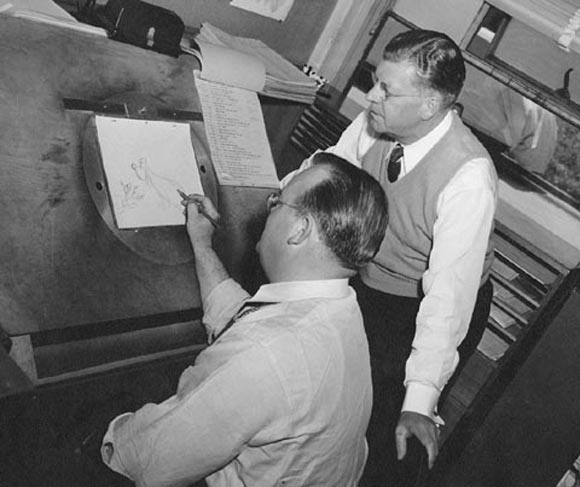
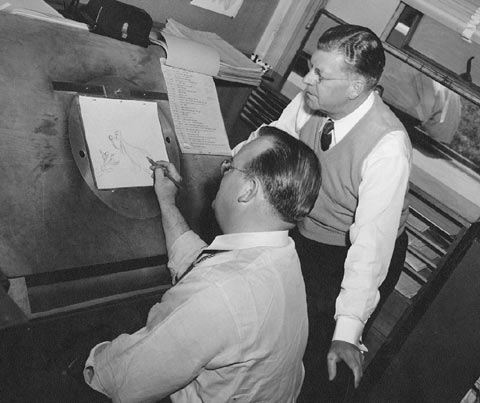 Director Tex Avery and exec Fred Quimby at MGM
UPDATE: See also What Frank Zappa, Tex Avery and Monty Python have in common
(Thanks, Seamus Walsh, for the Zappa link)