.png)
Tartakovsky, Harmon, Cappa Talk Animation Craft At Adult Swim’s L.A. Roundtable
Stay informed with free updates
Sign up to get our news digest — delivered directly to your inbox twice a week.
LOS ANGELES — Irreverent as the shows themselves, this week’s Adult Swim FYC panel at the Television Academy highlighted three of the company’s offbeat contenders in the running for Emmy Awards: Primal, now in its third season; Rick and Morty, which saw its eighth season in 2025; and the strangely delightful Haha, You Clowns, one of its most recent releases.
“We try not to do a single aesthetic or one kind of thing or a house style. Instead, we always try to back creators that have something interesting to do, and we trust in animation to convey their vision,” opened Adult Swim’s president, Michael Ouweleen, who flew in from Atlanta to moderate the event. Clips from the show’s specific episodes submitted for Emmy consideration screened ahead of a conversation with the trio of creators.
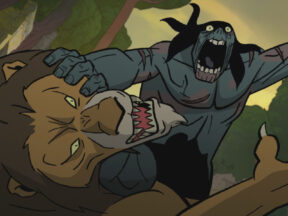
Genndy Tartakovsky picked “Feast of the Flesh,” in which the protagonist, Spear, is resurrected but doesn’t remember his family, as the episode to represent Primal because he thought it was simultaneously “emotional” and “horrific.” The portion screened shows Spear protecting a small grasshopper that reminds him of his dinosaur friend, Fang.
“It’s got this duality to it. We always like when Primal starts slow, and so this one, you really want to feel the jungle and feel this naked death walking through life,” explained Tartakovsky. “There was all this great juxtaposition, this great kind of visual poetry, and the whole idea of being emotionally connected to this [grasshopper] and wanting to protect it and then jumping into this cave of horrors, it kind of spoke to us.”
Rick and Morty co-creator Dan Harmon’s ongoing joke throughout the evening was complaining that Tartakovsky had an unfair advantage, given his show is hand-crafted. “He’s cheating. You can’t just draw your cartoon. That’s cheating. I want him disqualified. For your inconsideration,” he said with humorous exasperation. Before going on stage, Harmon said, he and Haha, You Clowns creator Joe Cappa were discussing their use of the Toon Boom Harmony software, and when they asked Tartakovsky which app he used for “twinning,” he simply stated Primal is hand-drawn.
“This show was made for me basically. It’s very sincere. I never knew if there was going to be an audience. If people would have the patience to watch it. And it’s very pure me. That’s probably the purest thing I’ve ever done that’s inside my head,” Tartakovsky said about Primal. Tartakovsky has found that the series can, in fact, keep viewers invested even if it’s a purely visual proposition with no dialogue, existing in a second-screen culture where people watch TV or films while also scrolling on their phones.
“I realized that in the second episode, I flew to Atlanta to have a screening there, and it was lunchtime, and you guys ordered pizza, and everybody gathered to watch it. And this guy was sitting next to me, and he took one bite and then the show started, and he just sat there like this [makes an entranced face] and he didn’t take another bite.”
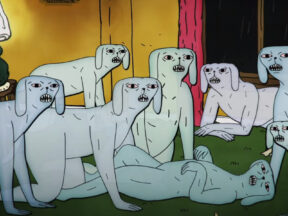
To represent Haha, You Clowns, which follows three kind-hearted brothers and their father, Cappa chose the episode “Therapy,” in which the boys have a session with a male therapist whose spiel sounds straight out of a manosphere podcast. The therapist tries to convince the kids that there’s something wrong with their close bond with their dad.
“These boys at the heart of the show, they love their dad, and that’s what it’s about. And I thought it was funny that they love their dad just because sitcoms, they’re always rolling their eyes, but they’re like, ‘This guy is awesome.’” Cappa developed Haha, You Clowns as part of Adult Swim’s Smalls program dedicated to fostering short-form projects from emerging talents in the animation industry.
About the peculiar look of the characters in his show, which has already been renewed for two more seasons, Cappa has said it is as if a live-action director were given an animated show, but he or she doesn’t know how to draw, and they’re trying their best. Now that he’s staffing for season two, he’s also come up with another example to describe the look.
“My favorite thing is when you’re outside of an art class in high school or middle school, and you can see the wall of pencil-drawn portraits of athletes or movie stars that this kid loves, and it’s just a little bit off,” said Cappa. “To me, that’s just like the height of comedy.” Cappa also voices all four main characters, which allows him plenty of creative control.
On the opposite end of the spectrum, Harmon spoke about how the shackles that come with being faithful to the show’s canon are one of the biggest hurdles in the creation of Rick and Morty. “Canon sucks, it drags your show down, but it’s also what you guys love, so when you can do it without fucking up the show, it’s a great thing,” he said.
The rather complex episode in contention on behalf of Rick and Morty is “Hot Rick,” which Ouweleen tried to summarize: “Memory Rick, who recruits a young Beth and trains her all of her life to try and recover the lost memory, the erased memory of Diane, Rick’s wife, that another version of Rick erased, like it super, super intense. And Rick does this, so that he is emotionally available to date a hot bug woman that you saw in the clip.”
Harmon noted that the idea of being haunted by a past self is “as old as Dickens.” Approaching the episode as “a memory of Rick that’s in Jerry’s brain” allowed them to bypass the constraints of the canon since the events that unfold in this context don’t affect the show’s definitive timeline. “It gets insane, so we were like, ‘Just make it an FYC episode,’” Harmon half-joked about the rather intricate storytelling in this episode.
Because of Rick and Morty’s longevity and the imposing canon, Harmon said the show had long been religiously script-driven. Now, the fact that the show has been around for so long has enabled the production to introduce more visual storytelling as part of its process.
“There’s a culture in animation where there’s a supposed dichotomy of script-driven versus board-driven. And to slowly move to a beautiful hybrid, which is what it always has been and should have been, where you realize anyone that imposed that dichotomy was the enemy, for me anyway, could only happen through time and trust,” said Harmon.
The times that the show has been saved by animators, Harmon said, have been plenty.
“It’s become a normal thing, for even junior writers on Rick and Morty, they’re coming into a school of thought where they’re encouraged as writers to not waste their time trying to Isaac Asimov-describe a gunfight and instead actually do what feels like hackery and cheating to a writer, which is to say, ‘Artists go crazy here,’” Harmon continued.
Though some might see this as “lazy,” Harmon said, relying more heavily on animators has, in fact, expedited the pipeline. Writers are not asking animators to do anything over and over again. “We found the more we did that, the less we had to re-break stories. Because it turns out, I guess people who draw stuff for a living know how to make stories happen,” he said.
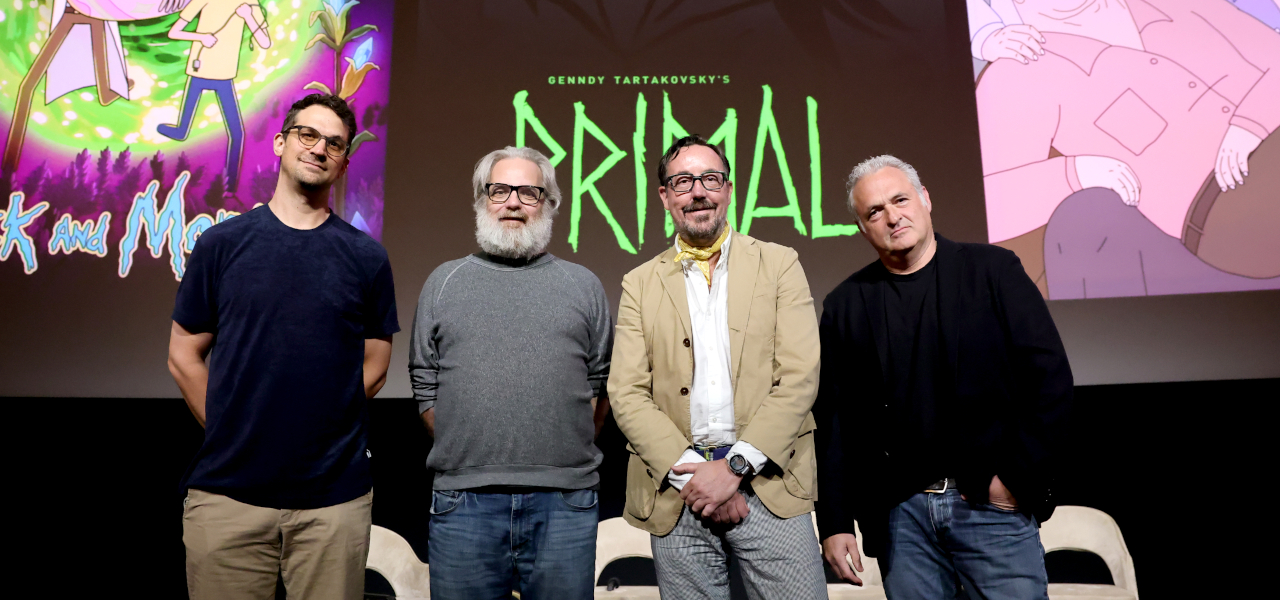
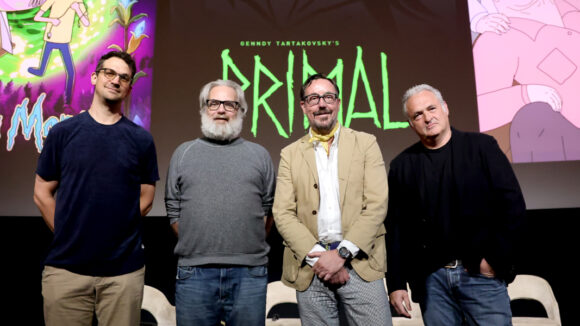
Pictured at top: Joe Cappa, Dan Harmon, Michael Ouweleen, Genndy Tartakovsky