.png)
2026 Oscars Short Film Contenders: ‘Trash’s’ Team Of ESMA Student Filmmakers
Stay informed with free updates
Sign up to get our news digest — delivered directly to your inbox twice a week.
Welcome to Cartoon Brew’s series of spotlights focusing on the animated shorts that have qualified for the 2026 Oscars. The films in this series have qualified through one of multiple routes: by winning an Oscar-qualifying award at a film festival, by exhibiting theatrically, or by winning a Student Academy Award.
Today’s short is ‘Trash,’ directed by ESMA students Gregory Bouzid, Maxime Crançon, Robin Delaporte, Matteo Durand, Romain Fleischer, Alexis Le Ral, Margaux Lutz, and Fanny Vecchie. The short earned its Academy Award qualification with an animated short win at Cinequest Film Festival before later taking best in show at Siggraph.
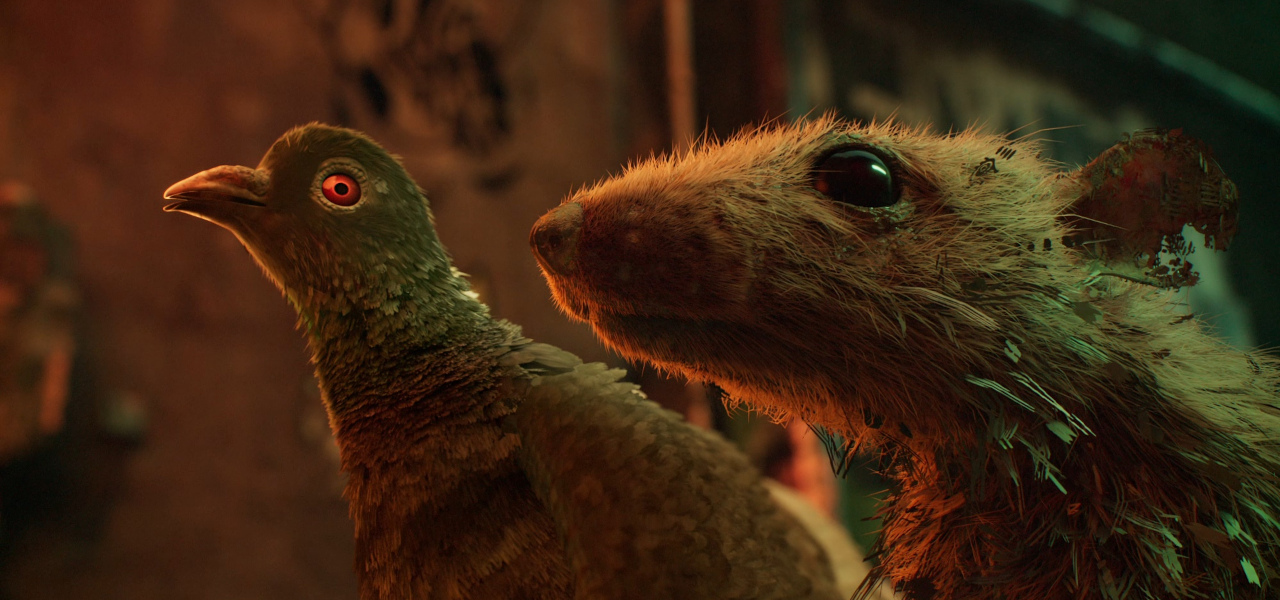
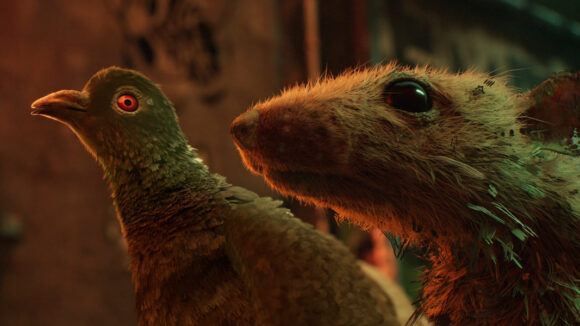
The stylized CG short follows a chase between a rat and a pigeon through the alleys and crumbling buildings of a dystopian, decaying metropolis. Beyond the straightforward narrative, the film raises questions of the future of humanity and where our priorities lie, while also leaving space for hope and tremendous beauty. The flame effects are breathtaking.
Cartoon Brew: What was it about this story or concept that connected with you and compelled you to direct the film?
Durand: What drew me to Trash was its dark and original concept. From the very beginning, the story had a strong connection between atmosphere, staging, and music — something that immediately inspired me. The idea itself instantly brought vivid and striking images to my mind, and I was fascinated by how visually powerful it could become. I felt there was a real opportunity to create a film that was both unsettling and beautiful, where each frame could leave a lasting impression. That combination of darkness, emotion, and visual ambition was what made me want to be part of it and help bring it to life.
It was also a really exciting project to imagine together. Before even having the idea for the film, our team was already a group of friends, so developing Trash felt natural and fun. We shared many common references and a similar artistic sensibility, but each of us also brought our own imagination and personality to the project. That mix made the creative process very rich — it felt like we were building a world that truly belonged to all of us.
What did you learn through the experience of making this film, either production-wise, filmmaking-wise, creatively, or about the subject matter?
Vecchie: Making Trash was a really valuable learning experience. On the production side, I learned how to work within a real studio pipeline and how to handle each step and unexpected issues with organization and precision.
Creatively, this project helped me develop my eye for visual detail and storytelling through images. We did a lot of research to reach an art direction that we all loved, and all the tests we did to achieve that stylized yet realistic and deconstructed look taught me a lot. On a more personal level, the story of this film and the feedback we received from people who watched it strengthened my desire to create meaningful stories.
Can you describe how you developed your visual approach to the film? Why did you settle on this style/technique?
Bouzid: Since the beginning of the preproduction, we always wanted to aim for an artistic direction that could suit the dirty and repulsive universe of the movie. We at first explored various styles such as clay-like materials or watercolor. But the one that stood out was about covering everything physically with brushstrokes, so it could be destructuring the naturally perfect shapes and aspects of the 3D objects.
We were inspired by the amazing art of a Croatian academic painter, and now friend of ours, Bozo Balov, who works in a similar way, painting in VR, creating 3D characters that seem to have no internal structure. We adapted a workflow similar to his using different softwares, and created the tools we needed to obtain the result you can see in the movie. Every item is imperfect and the textures seem to leak out of the objects. It matches one of our main objectives for the visuals : “Find Beauty within the Dirty”.
Given that there are eight credited directors on this short, how did you handle the division of labor between you?
Crançon: At ESMA, we had the freedom to organize our team however we wanted, which made the division of labor come very naturally. Each member of the team had specific strengths and interests, so we built our workflow around those skills. At the same time, every major creative decision was discussed collectively. We wanted the film to feel coherent from start to finish, so maintaining open communication and regular team reviews was key. Whenever one department was under pressure, others would step in to help. It was a very collaborative process where everyone contributed beyond their main role.