.png)

2026 Oscars Short Film Contenders: ‘Butterfly Kiss’ Director Zohar Dvir
Stay informed with free updates
Sign up to get our news digest — delivered directly to your inbox twice a week.
Welcome to Cartoon Brew’s series of spotlights focusing on the animated shorts that have qualified for the 2026 Oscars. The films in this series have qualified through one of multiple routes: by winning an Oscar-qualifying award at a film festival, by exhibiting theatrically, or by winning a Student Academy Award.
Today’s film is Butterfly Kiss from Zohar Dvir, produced by The Hive and Fabian&Fred. It earned its Oscars qualification by winning the Gold Hugo award for best animated short at the Chicago International Film Festival.
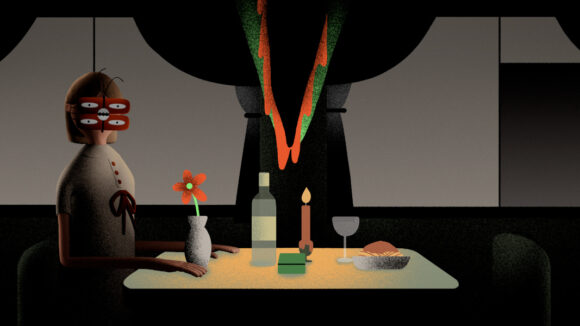
The highly relatable short centers on Carol, who’s comfortable in her routine but terrified of change. After an unexpected proposal from her girlfriend, Ray, panic sets in. The situation soon turns apocalyptic as Carol realizes that Ray – and nearly everyone else – is transforming into a human-butterfly hybrid. The film’s twist elevates a familiar fear-of-commitment story into a striking body-horror metaphor that’s as unsettling as it is visually stunning.
Cartoon Brew: What was it about this story or concept that connected with you and compelled you to direct the film?

Zohar Dvir: Ever since I was four years old, I watched horror movies with my dad. He would always explain them in a way that felt suitable for kids — “Look how the nice little worm crawls into the cute girl’s ear.” I grew up watching a lot of horror films with him, and although I became a bit of a scaredy-cat over the years, I’m still a fan of the genre. Fast forward to the beginning of the pandemic: I had just finished my graduation film and started thinking about a love story set during an apocalypse — the spirit of the times was fertile ground for horror. The butterflies came in because I wanted to explore the fear of change, and the butterfly became the perfect symbol for that. I also knew I wanted to write a lesbian love story. I thought a lot about LGBTQ+ representation in film and television, where queer couples are so often given tragic endings. It was important to me that my couple would stay together. At the same time, it’s a very personal story, inspired by my own relationship.
What did you learn through the experience of making this film, either production-wise, filmmaking-wise, creatively, or about the subject matter?
Making Butterfly Kiss was a great lesson in how to speak about reality through fantasy. Working with animation and the horror genre allowed me to create some distance from the story — in a good way. It’s no longer me and my partner, or our direct reality, but I think the film’s nightmarish essence manages to reveal something true about relationships in a more interesting way than simply showing a couple going through a difficult moment. I also learned a lot about directing others. The pipeline was quite complex: I worked with both 3D and 2D animation. I had a team of animators and background artists working in two different countries, and I had to learn how to navigate that process and piece the puzzle together.
Can you describe how you developed your visual approach to the film? Why did you settle on this style/technique?
In the film I combined two techniques — 3D characters set against 2D environments. This contrast was intentional: I wanted to create a sense of disconnection between the characters and their surroundings, echoing the film’s framing story. For the color palette, I started with tones reminiscent of concrete and added two dominant hues. Green represents nature, but I also used it to tint the entire apartment, creating the feeling of being inside a cocoon. The second is a vivid orange-red, symbolizing both love and the monarch butterfly. The overall aesthetic is minimalist with a retro touch, reflected in the characters, the interior design, and the architecture outside. This choice ties into the motif of fearing change, while also serving as an homage to directors I admire who worked within this genre — Hitchcock, Lynch, and Kubrick
The story in your short will feel familiar to almost anyone who’s been in a long-term relationship. What did the body horror genre offer to the metaphor you used to tell it?
The horror functions as a metaphorical lens to capture just how terrifying this situation feels for Carol. The entire film unfolds like a nightmare: she drifts in and out of sleep, slipping between realistic and surreal situations. The butterfly – a permanent disfigurement on her girlfriend’s face – embodies the transformation of their relationship, a change Carol resists. Her partner has changed, and so too must their bond; Carol either learns to accept it, or the relationship will collapse. In the end, the change erupts from within her: she vomits, and the vomit transforms into a cocoon, a visceral preparation for her own metamorphosis. Whether this transformation is chosen or forced remains deliberately unanswered.
