|
|
|||||||
|
|||||||
|
Search Results
August 5, 2009 6:02 am
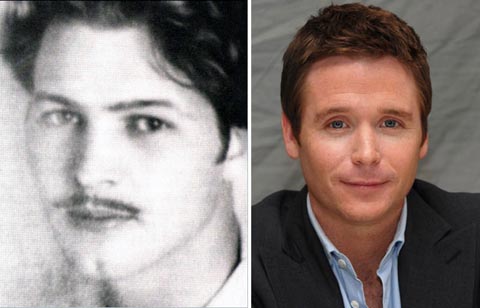
Victor Haboush passed away on May 24, 2009 at age 85. A first-generation American of Lebanese descent, he was born on April 16, 1924 and grew up in Indianapolis, Indiana.
During World War II, he took part in the D-Day landings at Normandy as a member of the Coast Guard, and later served in the Pacific theater. (His brother was mortally wounded at Leyte.) Following the War, he attended Art Center College of Design on the G.I. Bill where he studied extensively with Lorser Feitelson.
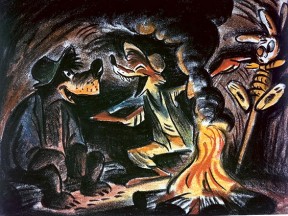
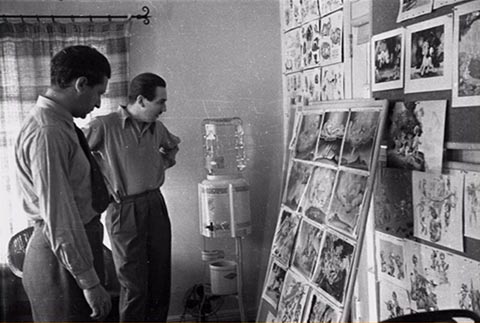
On the recommendation of his Art Center classmate Eyvind Earle, he was hired at Disney in 1952 to help finish layout on Peter Pan. His first association with Disney came earlier, when he helped Earle draw this Golden Book adaptation of Peter Pan. He built up an impressive list of credits at the studio including assistant art direction on Melody and Toot Whistle Plunk and Boom, and layout on Lady and the Tramp, Sleeping Beauty and 101 Dalmatians.
Vic was one of Tom Oreb’s closest colleagues during the 1950s and they worked together as a team, especially in Disney’s TV commercial unit. The characters in this Cheerios ad were styled by Oreb with background layout by Vic: He described to me in 2000 his relationship with Oreb:
When Oreb left Disney to work at John Sutherland Productions, Vic followed, and they worked together on films like Destination Earth and The Littlest Giant. They both soon returned to Disney to finish Sleeping Beauty, where Vic played a key role in designing the “Thorn Forest” sequence. In an interview, he spoke about his work on the sequence:
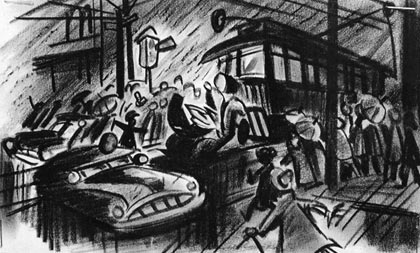
Vic worked at numerous other animation studios besides Disney, including Quartet Films, early seasons of The Flintstones and The Jetsons at Hanna-Barbera, and The Incredible Mr. Limpet at Warner Bros. He was the art director of UPA’s second feature Gay Purr-ee as well as the Mr. Magoo and Dick Tracy TV series.
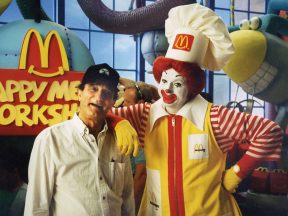
He told me that one of the most embarrassing moments in his career was during a short film screening at the Academy. UPA owner Henry Saperstein had submitted one of the Dick Tracy episodes for Oscar consideration, and when Vic’s name appeared onscreen as art director, he shrunk low into his seat. Working on the inferior UPA TV shows made him realize the direction the animation industry was headed and he resolved to set out on his own. In the early-1960s, he launched a studio, Spungbuggy Works, in partnership with animator Herb Stott and storyman/designer/all-around creative dynamo John Dunn. It was at this studio that he worked with Dunn to develop numerous feature and TV concepts, many of which would be later produced by Friz Freleng, who lured Dunn to his studio DePatie-Freleng. In the mid-1960s, Vic left animation and shifted into live-action. He started his own studio, Victor Haboush & Associates, which later became The Haboush Company. Over the next thirty years, he directed and photographed over 1,500 commecials, winning numerous Cannes Gold and Silver Lions, Clios and IBAs. His campaigns included the Kibbles N’ Bits “The Hook” campaign, numerous commercials featuring Ronald McDonald for McDonald’s, the Taco Bell “Crashing Bell” series, the Hefty Bag series with Jonathan Winters, early Keebler Cookies spots, and the Schlitz Malt Liquor “Bull” campaign.
One of his former producers Paul Babb said, “Vic was one of the go-to guys in the 1960s, ’70s and ’80s for commercials…He was no businessman but he was an incredible artist—and not just as a director. Try putting a pencil or a paintbrush in his hand, sit back and wait for something remarkable.” Vic might have agreed with the sentiment that he wasn’t an expert businessman. He knew how to sell an idea and he knew how to execute, but he was more interested in achieving a quality result than heeding the bottom line. He often told me that his studio wouldn’t have lasted had it not been for his brother, who served as his producer for many years. Jon Derovan, who was Vic’s producer during the final decade of his career, told Shoot magazine, “Victor allowed me to be a creative producer. He brought me into the creative process beyond the nuts and bolts of the business….He was generous. He was open to good ideas no matter where they came from–and he was quick to credit the person who came up with the idea. He would never take credit for an idea that wasn’t his.” Even while he ran the studio, he remained connected to animation and art. He employed many animators over the years including John Kimball, Robert Swarthe, Dale Case, and the unheralded Robert Mitchell. Through his company, Vic produced three shorts directed by Mitchell—K-9000: A Space Oddity (1968), the Oscar-nominated The Further Adventures of Uncle Sam (1970), and Free (1972). His company also produced another art film, Paint (1968) directed by Norm Gollin and starring LA airbrush pioneer Charlie White: I first met Vic around the year 2000 while I was researching the life of Tom Oreb. By this time, Vic had retired from filmmaking and was painting full-time. We hit it off and formed a friendship that endured until his death. Vic’s attitude towards life was different from the majority of older people I’ve encountered. He was young at heart, with an insatiable curiosity about the world around him and a flexible thought process. His opinions about different artists evolved over time, much like his distinctive painting process, which often involved reworking an image dozens of times until he was satisfied. He refused to live in the past. Whenever we would get together, he couldn’t wait to discuss people he’d recently met, a new place he had visited, or a new book he’d read. He was as enthusiastic about younger artists as he was appreciative of veteran artistic colleagues. When he returned to animation one final time as a development artist on The Iron Giant, he became enamored with artists like Mark Whiting and Teddy Newton, the latter whose work he felt was some of the freshest he’d seen in a long time.
To fully appreciate Vic, you had to know him in person. Charismatic and energetic even in later years, his social skills were second to none. Not only could he strike up a conversation with a random stranger, but he could also get their contact info and perhaps form a long-term friendship—and remarkably, he could do all of this inbetween sips of his morning coffee. He was Malcolm Gladwell’s concept of the “connector” personified.
I always considered him more of a pal than a teacher, but looking back on the time we spent together, he was one of the most influential mentors I ever had. His enthusiasm for art was contagious and instilled in me an appreciation for the same, from Lundeberg to Diebenkorn to Vlaminck to Pascin. Vic didn’t always have the easiest time imparting his wisdom. He once spent an entire morning trying to explain to me why Cézanne’s work was such a remarkable accomplishment. I was too dense at the time to grasp what he was saying, but it eventually sunk in. He was one of the earliest supporters of my writing, and we spent months developing a story book together, which gave me the opportunity to see how skilled he was handling story and character. He prodded me for years to pursue writing seriously, and that too eventually sunk in. I remember during one visit I had brought my camera along and he asked me to take a photograph of him. The results were less than spectacular. The director in him emerged, and I received a firsthand taste of what he must have been like to work with on a live-action set. With the assured confidence of a master cinematographer, he directed me where to stand and where to point the camera, and he set himself up properly in the natural light. Within seconds, we had a fine portrait. Thank you, Vic. For being a mentor, an inspiration, and a friend. It was an honor knowing you. He is survived by his wife Monica, three children—Auguste, Cedric and Laila—and six grandchildren.
April 15, 2009 12:25 pm
Alan Coats, the son of legendary Disney background painter Claude Coats, has started a website about his father’s work at ClaudeCoats.com Right now, the site is mainly a storefront that sells giclée prints of Coats’ personal paintings, some of which are quite attractive. I hope Alan eventually fleshes it out with more family photos, personal ephemera, and career details as well. One of the unexpected delights of the Internet age has been seeing the children of Golden Age animators launch websites devoted to their parents. After toiling in anonymity for their entire careers, it’s fitting that these artists would finally receive marquee recognition with entire destinations devoted to their individual accomplishments. The gold standards for family-operated artist sites are AbeLevitow.com, BillPeet.net and this incredible blog by Irv Spector’s son. (link via Disney History) October 31, 2008 9:48 am
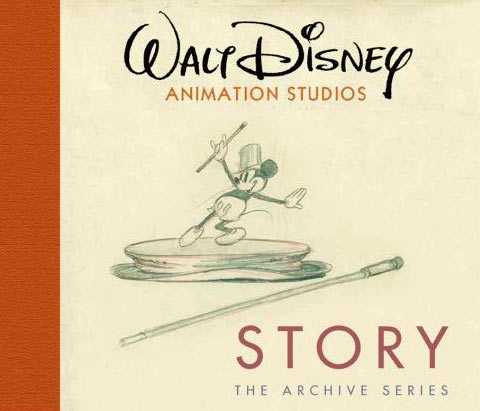
The first volume in the Disney Archive Series is coming out in a few weeks. I saw the galleys for this a while back and it’s a real treat if you’re looking for a collection of beautiful story artwork. It’s available for pre-order on Amazon for $31.50. Here is the book description:
February 21, 2008 1:55 pm
If you’ve ever wondered why Disney story artist Bill Peet is often referred to as a master draftsman, look no further than these never-before-published drawings by Peet for a planned storybook about Susie the Blue Coupe. They’re posted in two parts on Michael Sporn’s blog: Part I and Part II. The story was turned into a Disney theatrical short in 1952. It can be viewed on YouTube. An interesting note about the film: Hans Perk, a reliable Disney authority, says in the comments of Sporn’s post that Susie the Blue Coupe is one of a handful of Disney shorts that has lapsed into the public domain. So remix away folks! January 7, 2008 11:05 am
If there’s one thing the animation blogging community guarantees, it’s plenty of controversy. The latest squabble that has evolved is about who wrote animated shorts and features during the Golden Age of animation. In one corner is Steve Worth of the ASIFA-Hollywood Animation Archive, who claimed that artists drew storyboards and that “THERE WERE NO CARTOON SCRIPTWRITERS prior to 1960.” (his emphasis). On the other side is historian Michael Barrier, who offers evidence that Bill Cottrell was one example of a scriptwriter at Disney in the 1930s. Then there were artists like Bill Peet who did both screenwriting and storyboarding on a film like 101 Dalmatians. In a recent Variety interview, director Brad Bird offered some comments, which while not specifically addressing this argument, seem to be quite appropriate. Bird said, “The whole question of writing for animation is skewed. There isn’t a giant difference between animation and live action. You need characters, stories, themes. It’s called good storytelling…I write scripts first, before the work gets to the storyboarding stage. But I write with the knowledge of what animation can do.” His comments make perfect sense, but with the caveat that the animation world rarely attracts storytellers the caliber of Brad Bird and Bill Peet, which is why animation suffers today and why engaging storytelling is the exception instead of the rule. A sidenote: the Variety link above is also worth checking out to hear about some of Bird’s favorite film writers. December 3, 2007 10:59 am
The animation history round-ups have become one of my favorite types of posts to do on Cartoon Brew. It is always eye-opening to see the wealth of classic material that appears on-line on a regular basis. The cartoon history being posted online is about as grassroots as an effort gets, lots of various people (animation historians, the families of artists, and students and fans of the art form) coming together to share things from their collections without any specific agenda. There’s also no financial incentive here, only the desire to help one another and the art form grow and prosper. It will be exciting to see how the new generation of artists learns from this material and pushes the art form even further forward.
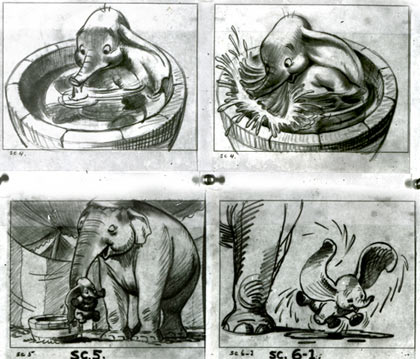
• Powerful Dumbo storyboards by Bill Peet are matched only by powerful Dumbo animation by Bill Tytla. • Rare drawings by Playboy cartoonist (and former Disney story artist) Eldon Dedini (via Flog!) • Animation director Ward Jenkins examines the Tex Avery-Tom Oreb classic Symphony in Slang (1951). • A Virgil Ross-animated pencil test of Bugs Bunny from A Hare Grows in Manhattan. • The wonderful commercial animation of animator Jack Schnerk can be seen in the reel below as well as the second and third reels on YouTube. Director Michael Sporn offers some memories of working with Schnerk on his blog. • “It is a well-known fact at Disney’s that a man has to love an animal thoroughly before he can draw it well,” says this 1942 article from Nature magazine about the making of Bambi. • Animation director Bob Jaques offers an appreciation of Jim Tyer’s animation in the 1946 Popeye cartoon The Island Fling. Previously on Cartoon Brew: May 11, 2007 4:47 am
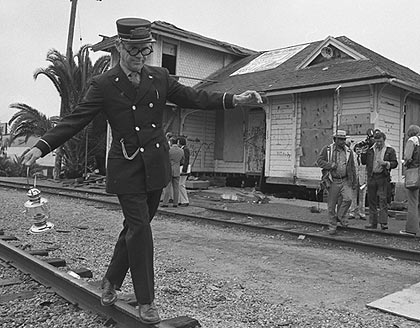
Earlier this week, UCLA’s Department of Special Collections unveiled a new searchable website that houses 5,100 hi-res images from the archives of the LA Times and the original Los Angeles Daily News. Most of these images haven’t been seen since they were originally published in the newspapers. I was curious if there were any animation related photos among the collection and I’ve posted my finds below. Bear in mind that the entire archive consists of 3 million photos so the images online represent only a tiny fraction of the collection. The animation and cartoon-related photos include images of Carl Urbano, Bill Peet, Gus Arriola, Matt Groening, June Foray, Phil Interlandi, Hank Ketcham, a couple Ward Kimball pics (1, 2), some nice shots from the Disney strike of ‘41 (1, 2), a few Walt Disney photos I’d never seen before (1, 2, 3), and a Snow White float from the 1938 Rose Parade. (via LA Observed) June 28, 2006 4:24 am
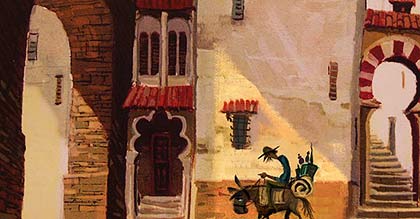
![]() Haven’t done this in a while so here’s a look at some artist blogs that I recommend… Samuel Michlap has some mighty incredible paintings on his blog. The one at the top of this post was for the DreamWorks feature ROAD TO EL DORADO. Must I make a comment comparing this to the finished product? Curtis Jobling: designer, book illustrator, novelist, series creator…and he still has time to blog. I’m not sure how he does it all, but among other things, he’s the designer of the hit British children’s series BOB THE BUILDER and the creator of FRANKENSTEIN’S CAT, soon to be the first 2D animated series produced by British puppetmakers Mackinnon & Saunders. Spumco-Ottawa pals Chris Dainty and Jessica Borutski (of I LIKE PANDAS fame) are documenting the development of their new TV series concept, THE CONSTELLATIONS. Looks like a fun and appealing idea. Conversations on Ghibli is pretty much what it says. If you’re a fan of Studio Ghibli, Miyazaki and Takahata, then chances are you’ll enjoy this blog. Mark Kennedy is a storyboard artist at Disney, and his posts offer superb pointers on drawing, design, composition and boarding. And there’s also drawings by Bill Peet and Milt Kahl. I’m satisfied with that. Canadian animation artist Nick Sung has been working on a personal project called ONE MAN BAND (not to be confused with the Pixar short of the same name). It’s not a film, but a portfolio book/leica reel that was produced in a very limited run of two copies. He explains the genesis of the project HERE and HERE. Nick’s art is beautifully drawn and designed, and the large number of posts over the past three months offer a valuable insight into his working process. ![]()
|