|
|
|
|
TAG FOR “Illustration”Cartoon Brew's home for up-to-the-minute, unedited announcements and press releases direct from industry sources.
March 26, 2012 10:23 am
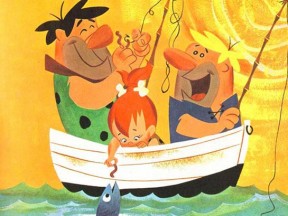
![]() As if yesterday’s news of the Nine Old Men flipbook set wasn’t tantalizing enough, there’s also the Mary Blair Treasury of Golden Books
Pre-order is $13.59 on Amazon March 10, 2012 4:59 pm
RIP, French comic artist and illustrator Jean “Moebius” Giraud, who has passed away from cancer at the age of 73. This is a good place to begin learning about his work. His best known film design work is in live-action, like The Abyss, Alien, TRON and The Fifth Element, but he also contributed to a number of animation projects including Little Nemo: Adventures in Slumberland, Space Jam and Time Masters (below). He was revered in France where they exhibited his comic art with respect and appreciation. Moebius influenced many people in our industry. I’ve collected some of the animation community’s reactions on Twitter: January 26, 2012 2:57 am
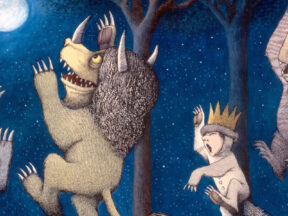
Stephen Colbert’s two-part interview with Where the Wild Things Are author/illustrator Maurice Sendak easily ranks as the most entertaining interview I’ve ever seen with a children’s book author. I’m sure it’ll be much discussed at the Society of Children’s Book Writers & Illustrators winter conference, which starts tomorrow in Manhattan. January 4, 2012 2:41 am
In memory of Ronald Searle’s passing, we present this tribute by Matt Jones. Besides working as a story artist at Pixar, Matt is the curator of the Ronald Searle Tribute blog, a fantastic repository of Searle’s artwork and a required first-stop for anyone interested in his work. In the piece, Matt speaks about the friendship he formed with Ronald Searle in the final years of his life. My Friend, Ronald Searle Disney’s Nine Old Men, Ken Anderson, Chuck Jones, Tex Avery, Bob Clampett, Joe Grant, Art Babbitt . . . all the American icons of animation had already left us. I moved to the United States too late to meet any of them, but at Pixar I work with many people who had the privilege of knowing and learning from these legendary artists, and I listen to their tales with glee. When I lived in Europe, however, there was still one legendary artist left who had outlived them all, one who had influenced them all, and one who I was fortunate to meet and get to know—the incomparable Ronald Searle. I first became aware of Searle’s work trawling the second hand bookshops on London’s Charing Cross Road. His work struck me as the forebearer of a British cartooning tradition dominated by Ralph Steadman and Gerald Scarfe at the time. I had discovered them in art school and came to realize that Searle was the original master of the scratchy, spattered ink line, influencing all who followed. I was dissatisfied with the materials that were available online about Searle, and sought to establish a resource of choice scans from my growing collection of his books. I undertook the blog merely as a fan. Little did I know that I would later come to know the artist and even have him contribute material to the site. December 1, 2011 6:38 pm
This appealing, exquisitely colored 1952 magazine illustration of Snow White and the Seven Dwarfs by children’s book illustrator Gyo Fujikawa will be auctioned next week at the Illustration House. Fujikawa worked briefly at the Disney animation studio before she moved to New York to pursue a career in advertising and illustration. The auction estimate for the painting is $5,000 to $7,000. May 19, 2011 2:34 am
My favorite publisher Chronicle Books recently announced their fall publishing line-up and it includes three books that may be of interest to Brew readers: A first of its kind book: Setting the Scene: The Art & Development of Animation Layout
Sasquatch’s Big Hair Drawing Book
The Art of Pixar: The Complete Color Scripts and Select Art from 25 Years of Animation
June 21, 2010 1:32 pm
Shane Prigmore, whose character design talents have graced Coraline and How to Train Your Dragon, has illustrated his first book Spaceheadz Here’s a trailer for the book, the first in a series, that explains the concept: June 16, 2010 1:38 am
Animation artist Lou Romano (The Incredibles, Up) makes a strong case for using illustrations on magazine covers with this attractive cover for Written By magazine in honor of Ray Bradbury’s ninetieth birthday. Better still, there’s an artwork-heavy post on Lou’s blog documenting the creative process for this illustration. June 13, 2010 6:58 pm
The idea that Picasso was as much a cartoonist as fine artist is certainly not original, but it’s never been more evident to me than at the Picasso exhibition currently on display at the Met. It’s worth seeing if only for the last couple rooms which present a large selection of lithographs, etchings and drawings from his late years. These drawings are a revelation—piece after masterful piece of stunning cartoon design with some sequential storytelling also thrown into the mix. Looking at them, I couldn’t help but be reminded of the pen-and-ink cartoons of indie comic artists like Gary Panter and C.F, and by extension, animated shows like Adventure Time. It turns out that Picasso was an indie comic artist long before the term existed, and approached cartooning with an uninhibited and expressive approach that puts most of today’s indie comic practitioners to shame. I took some photos at the show. There’s more Picasso cartoons after the jump: June 7, 2010 4:05 am
Ronald Searle has not only inspired countless cartoonists and illustrators, his work has had a profound impact on animation artistry since the 1950s and continuing through today. A few years back, I was chatting in Annecy with fellow Searle aficionado Matt Jones about how amazing it would be if we could hunt down the reclusive, legendary artist and learn more about his work. Matt, who was living in the south of France at the time, did exactly that. He not only found the now-ninety-year-old Searle, but became friends with him. Recently he’s been presenting some lectures about Searle’s work with the cooperation and blessing of the master himself. It delights me to no end knowing that a new generation is discovering Searle’s genius through Matt’s efforts, which also include the indispensable Ronald Searle blog. The real purpose of this post though is to share this link that will allow you to watch a forty-minute lecture that Matt gave at the CTN Expo last November. Prepare to be inspired! June 2, 2010 12:12 pm
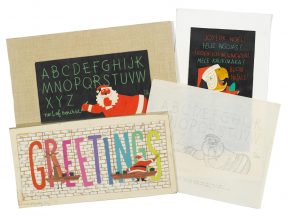
One of my recent book purchases is Studio Cards: Funny Greeting Cards and People Who Created Them The writer, Dean Norman, spent most of his career making “studio cards,” which is the name ascribed to a particular type of tall and funny greeting card that was popular from the Fifties through the Eighties. Dean worked both in Hallmark’s Contemporary department and American Greetings’ Hi-Brows, which were the “studio card” divisions of these two major greeting card companies. (He also worked in animation briefly at studios like DePatie-Freleng and Filmation.) Hallmark was based in Kansas City and American Greetings was in Cleveland—these were traditional midwestern companies that didn’t try to challenge middle American values as media companies on the coasts did. They were happy to put out products that served a simple and honest purpose, and get rich ten to fifteen cents at a time. As a result, the greeting card industry had little glamour (even less than animation) and few of the artists believed they were making anything more than functional commercial art. Within those boundaries though, they created some funny and memorable work. Some of the writers and artists discussed in the book will be undoubtedly familiar names—Robert Crumb, Tom Wilson of Ziggy and MAD’s Paul Coker, Jr.—while others are anonymous talents like Don Branham, Larry Raybourne, John Gibbons, Bob Harr, Teresa Satow, and Jimmie Fitzgerald, the latter two artists being women. The book compares favorably to Jack Kinney’s Walt Disney and Assorted Other Characters by managing to give the reader a sense of a time and place by focusing on individual artists. Norman’s stories (and he has a lot of them) made me smile and chuckle throughout, and by the end of the book, one walks away with a good sense of what it was like to work in the trenches of the greeting card biz. Animation artists will be able to commiserate with many of Norman’s stories, especially when he discusses editors and art directors: “A good editor or good art director is perhaps the most rare creature on this planet,” he writes. “But companies large and small have these positions to fill, and the people who fill them do great damage to creativity. Often the position of editor or art director is a reward that is offered to a good writer or a good artist…If you are good, you can stop writing or drawing and become a manager who harasses other writers and artists.” Norman tells maddening stories about management’s constant search for formulas, like how when a series of cards with short characters starting selling well, Hallmark art directors demanded every artist draw only squat characters. The book is illustrated with lots of greeting card examples and other ephemera that Norman collected over the years. It’s print-on-demand, so sadly it’s in black-and-white and the image quality is far from perfect. Also, as with most self-published projects, the book could have really used an editor to tighten up passages and help smooth out a lot of the chronological leapfrog. Having said that, I unequivocally recommend the book. It’s a valuable piece of history about a woefully neglected and undocumented area of commercial illustration and cartooning. Norman’s writing is heartfelt and his stories are delightful. If anything, this book helped convince me that Hallmark and American Greetings are sitting on some great archival material and that they should consider releasing compilations of all the funny cards they created. May 10, 2010 10:30 am
|