.png)
2027 Oscars Short Film Contenders: ‘9 Million Colors’ Director Bára Anna Stejskalová
Stay informed with free updates
Sign up to get our news digest — delivered directly to your inbox twice a week.
Welcome to Cartoon Brew’s series of spotlights focusing on the animated shorts that have qualified for the 2027 Oscars. The films in this series have qualified through one of multiple routes: by winning an Oscar-qualifying award at a film festival, by exhibiting theatrically, or by winning a Student Academy Award.
Today’s short is Bára Anna Stejskalová’s 9 Million Colors, a Czech stop-motion musical produced by Bionaut Animation with co-producer Divize, which we’ve been watching closely since seeing it pitched at Cartoon Springboard back in 2022. The film qualified for Oscar consideration through the Indy Shorts Film Festival, where Stejskalová previously won Best Student Film for Love Is Just a Death Away. After that pandemic-era win, she was able to attend this year’s festival in person.
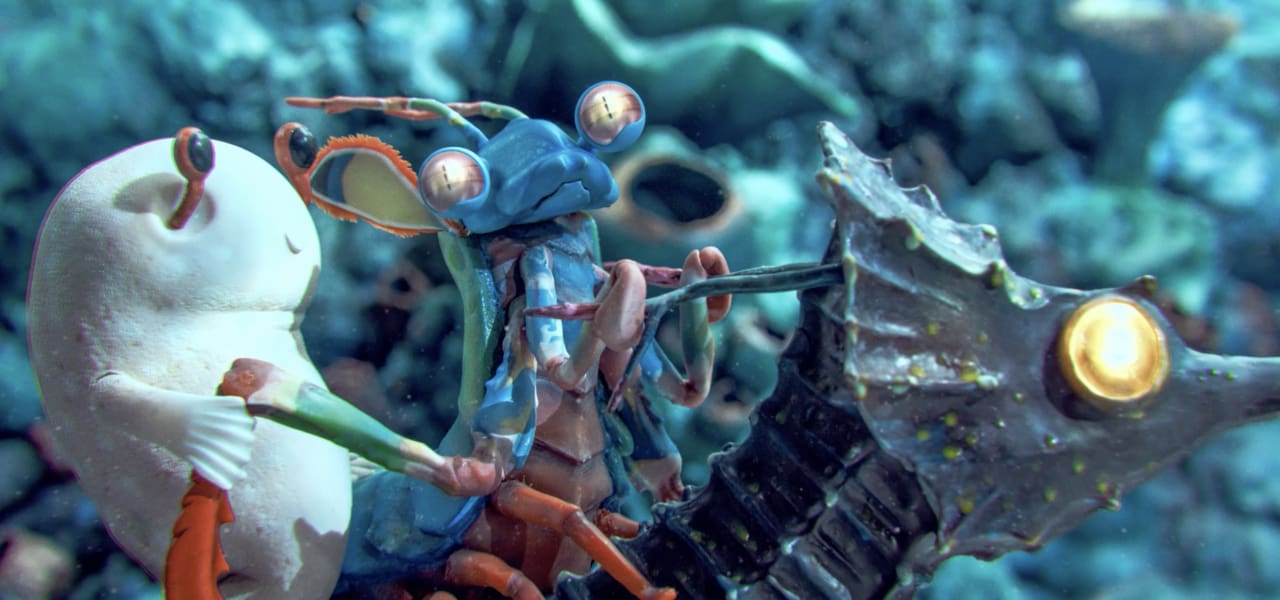
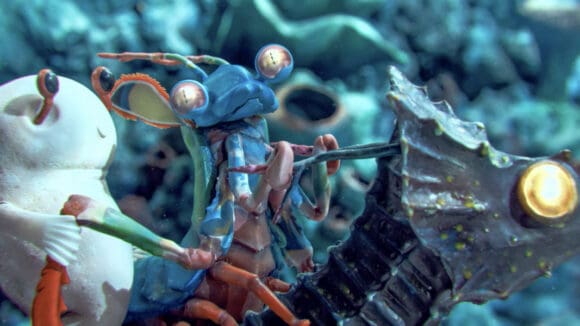
Following a mantis shrimp who befriends a blind fish, 9 Million Colors explores female friendship and the possibility of staying close when two individuals experience the world very differently. The shrimp’s extraordinary vision also shapes the film’s visual approach: Stejskalová and her team combined experiments with lighting and imagined color spectrums to create her underwater perspective. Projected sun rays, expressive puppet animation, and discarded plastic on the seabed give that world both its beauty and traces of human damage.
Cartoon Brew: What was it about this story or concept that connected with you and compelled you to direct the film?
Bára Anna: My desire with this film at first was to portray the different faces of female friendship. Being together through the good and the bad. The power of it, the intensity, which can sometimes almost border on love. As I progressed with the script, other topics became mixed into it as I continued living and experiencing new sides of relationships. Mostly, there was this question: if two people see the world in completely different colors, can they still be together? Also, ever since I learned about the existence of mantis shrimp, I have been a huge fan of this critter. She is truly fascinating, and I was up for the challenge of trying to capture how she might see the world. Nobody has really tried before, because it is a given that we will always fail, as our eyes simply aren’t as perfect as hers. But I couldn’t resist trying.
What did you learn through the experience of making this film, either production-wise, filmmaking-wise, creatively, or about the subject matter?
I learned to fail. Gracefully, of course, but over and over again. There were a lot of challenges during the production, from the animation, as we had to mimic the mass and movement of water with our puppets, to the music. Now I think it is perfect, but during development we found ourselves in so many dead ends. Then there were the POVs themselves, which we couldn’t create analogically as we had originally planned, and of course the whole financing of the film. The original idea was that the film would be 25 minutes long, and we ended up with 15 minutes. However, it is still amazing! At least in my eyes.
Can you describe how you developed your visual approach to the film? Why did you settle on this style/technique?
I like to base my films in reality. I went diving a couple of times so I could get a better idea of how light and colors actually work underwater. We ended up using mostly brown and blue tones in the “default” camera POV. For the mantis shrimp, I studied the color spectrum she can see. First, we did lighting tests with UV lights, experimenting with how ultraviolet, infrared, and polarized light could possibly look. Then I threw in a made-up color spectrum, mostly toned towards pink and aquamarine. We combined all of these layers in post-production and arrived at what her POV could look like. While designing the seabed, it was also important for me to capture it as it really is. So if you pay close attention, you can see toothbrushes, plastic bottles, pieces of plastic bags, and other rubbish. Just my little sad nod to the state of our oceans. Another challenge was redesigning the mantis shrimp so she would represent the qualities I wanted her to have, while also being likable and sassy. I had to shift some parts of her face around and combine her features with those of an actual praying mantis. For the fish, I ended up combining two kinds of deep-sea fish: a coffinfish and a faceless eel. I liked the skin texture of one and the shape of the other. She ended up as this well-rounded, innocent little creature.
View this post on Instagram
How did you approach animating the underwater movement and making it feel convincing without sacrificing the film’s stylization?
I think it was the stylization that helped the film the most. We used a projector to cast sun rays directly onto the set, which created the illusion of an underwater space even when we were shooting against green screen. But of course, most of it is thanks to the genius of our animators, who really poured their hearts and a huge amount of skill into the film. Namely Jiří Krupička and Vojtěch Kiss, together with Matouš Valchář and Tomáš Červený.