.png)


2026 Oscars Short Film Contenders: ‘Cafuné’ Directors Carlos F. De Vigo And Lorena Ares (EXCLUSIVE BTS)
Stay informed with free updates
Sign up to get our news digest — delivered directly to your inbox twice a week.
Welcome to Cartoon Brew’s series of spotlights focusing on the animated shorts that have qualified for the 2026 Oscars. The films in this series have qualified through one of multiple routes: by winning an Oscar-qualifying award at a film festival, by exhibiting theatrically, or by winning a Student Academy Award.
Today’s short is Cafuné from Spanish directors Carlos F. de Vigo and Lorena Ares, produced by Dr. Platypus & Ms. Wombat, New Gravity Laws, White Leaf Producciones, and Damian Perea Producciones. The short qualified for the Oscars by winning the 2025 Spanish Academy Goya Award for best animated short.
Set against the backdrop of Spain and Europe’s ongoing immigration crisis, this short, supported by Amnesty International, explores migration-related trauma through the eyes of a child. When Alma’s doll slips into a swimming pool, the moment triggers echoes of her perilous journey across the Mediterranean. As panic resurfaces, Luna, the volunteer who once saved her, steps in to guide her through the episode, offering steadiness, care, and a path toward healing.
Cartoon Brew: What was it about this story or concept that connected with you and compelled you to direct the film?
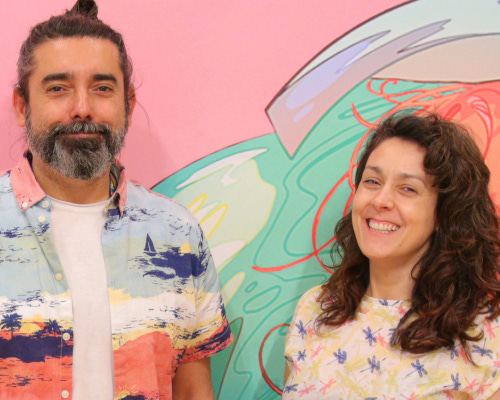
Carlos F. de Vigo, Lorena Ares: The four-page comic by Chechu Ramírez moved us immediately: a little girl falls into a pool and, as she resurfaces, she emerges into the memory of the shipwreck where she lost her mother. That transition between present and past felt incredibly powerful and deeply cinematic. We were also drawn to exploring forced migration through emotional scars, through trauma, not just the journey itself. From the start, we conceived the film as a drift inside Alma’s mind, moving between memories the way pain does: without order, without permission, without a timeline.
What did you learn through the experience of making this film, either production-wise, filmmaking-wise, creatively, or about the subject matter?
The biggest lesson was about empathy, and the danger of turning a human tragedy into a political debate. As Europeans, we feared not being the “right voice” to address forced migration, so we listened a lot: to volunteers, to people who lived these journeys, to Amnesty International, who supported us from the very beginning. We also did an exercise with our team: trying to find news articles that listed victims by name, not by number. We couldn’t. That realization was striking. We understood how accustomed we’ve become to statistics, how easily we stop seeing people, and how urgently we need to “de-anesthetize” ourselves.
Can you describe how you developed your visual approach to the film? Why did you settle on this style/technique?
We knew the film had to be animated: in live action, some scenes would be too distressing to watch, and viewers would look away. We needed the opposite; we needed them to stay with Alma. We tried several styles before realizing they didn’t work, and we dared to reset a production already in progress. The arrival of Grangel Studio defined the designs of Alma and Luna and set the tone. With Almu Redondo as our production design advisor, we found the balance: a soft, readable, never-grotesque line, with an authorial touch and a palette that clearly separates ocean, pool, and emotional refuge.
By centering the story on a child survivor, the film reframes the migration experience with a rare sense of vulnerability. What does Alma allow you to express symbolically about forced displacement that an adult character could not?
Choosing a child was essential. Alma is a blank canvas: no ideology, no prejudice, only the need to survive. Her extreme vulnerability makes it impossible for viewers to retreat into political arguments. An adult would arrive with history, anger, discourse; Alma arrives with fear and a need for affection. And her relationship with Luna reveals something important: Luna helps Alma heal, but Alma also helps Luna. The film speaks about migration, yes, but above all, it speaks about love that heals in both directions.


