.png)
2026 Oscars Short Film Contenders: ‘Inkwo For When The Starving Return’ Director Amanda Strong
Stay informed with free updates
Sign up to get our news digest — delivered directly to your inbox twice a week.
Welcome to Cartoon Brew’s series of spotlights focusing on the animated shorts that have qualified for the 2026 Oscars. The films in this series have qualified through one of multiple routes: by winning an Oscar-qualifying award at a film festival, by exhibiting theatrically, or by winning a Student Academy Award
Today’s short is Inkwo for When the Starving Return, directed by Amanda Strong, a member of the Manitoba Métis Federation, and produced by Spotted Fawn Productions and the National Film Board of Canada. The short has screened at top festivals around the world, winning the Grand Prize at View Conference and qualifying for the upcoming Oscars through exhibition.
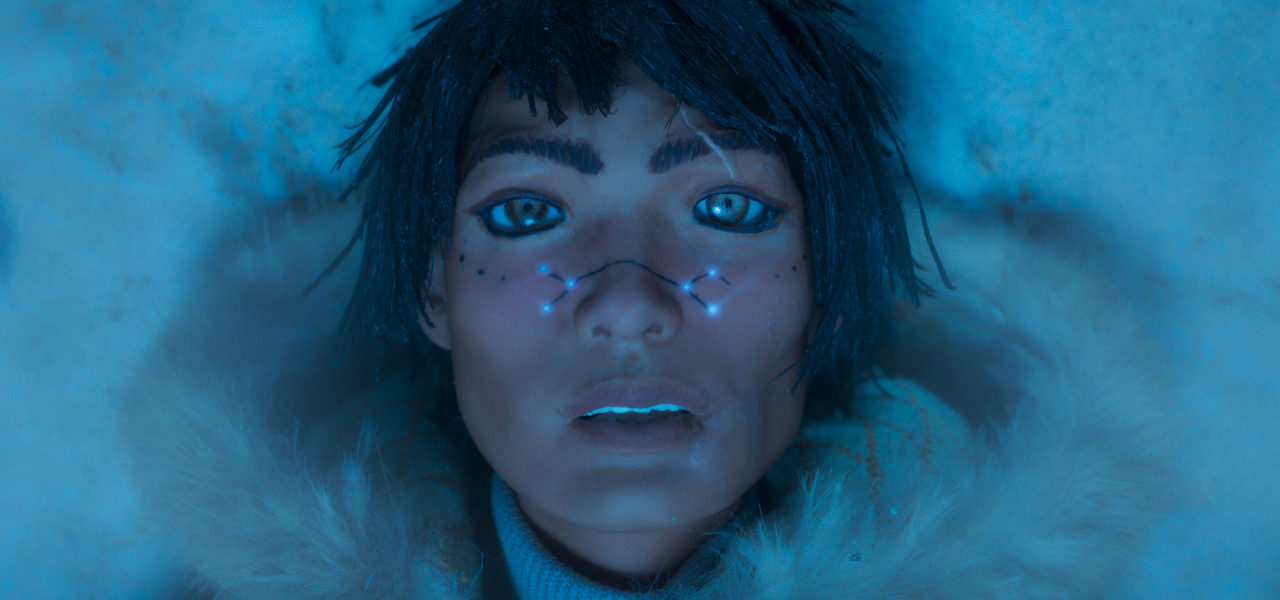
Featuring stunning and often terrifying stop-motion animation, Inkwo unspools in the far north and the near future, where the fate of the world rests on Dove, a mysterious warrior who can shift gender and must master their powerful Inkwo (medicine) to confront an ever-growing horde of ravenous monsters. As these soul-devouring beasts strengthen with each kill, Dove’s bond with the Earth becomes a rallying cry to resist the relentless forces of greed threatening all life.
Cartoon Brew: What was it about this story or concept that connected with you and compelled you to direct the film?
Amanda Strong: Inkwo was adapted from a series of writings by award-winning Tłı̨chǫ Dene author Richard Van Camp. I had goosebumps upon first reading it and knew I wanted to help dream this story into stop-motion animation. I felt the importance and urgency of what is at stake for our future generations, with greed and extraction being such giants in our world. I also resonated with the main character, Dove, as they move through an unbalanced world where terror is confronted with medicine.
What did you learn through the experience of making this film, either production-wise, filmmaking-wise, creatively, or about the subject matter?
My previous films were limited in the areas of facial animation and synced dialogue. My dream was to have puppets that could speak with an expansive expression range. The brilliance of Patrick Zung and Standing Figure helped realize this dream and aided in the evolution of the work we do at our studio. It was transformative to physically see the possibilities of head mechanics, silicone skins, and practical blinking that allowed for a new level of emotional potential. Most importantly, this creative and technical process was culturally guided by Georgina Franki, who helped form the cultural aesthetic and was instrumental in implementing the language into the piece.
Can you describe how you developed your visual approach to the film? Why did you settle on this style/technique?
Our path was formed by looking for ways to merge the handmade aesthetics of stop-motion with digital tools that maintain and serve the handcrafted world and animation. With Inkwo, we were trying to emulate and represent the vast landscapes of the Northwest Territories through stop-motion sets, but we knew we needed to merge with digital and 3D set extensions. We went through an extensive process of using the practical assets to inform the digital process, through 3D scanning and photogrammetry. This weaving of physical and digital data had the ultimate goal of expanding a stop-motion world, creating a space for the puppet animation to live within.
You describe the process as deeply collaborative and guided by Protocols and Elders. How did integrating those teachings and community perspectives influence key creative or technical decisions in the film?
My core values align with honoring both the community I am working with and how the story needs to be represented. It’s my responsibility as a director to navigate our stories’ sensitivities and work with community Knowledge Keepers to build a team and a safe space for dreaming and creation. It is also important for me to hold space for Indigenous lead creatives to strengthen our process of storytelling, one that honors protocol and teachings.


