2027 Oscars Short Film Contenders: ‘Saba’ Director Liron Topaz
Stay informed with free updates
Sign up to get our news digest — delivered directly to your inbox twice a week.
Welcome to Cartoon Brew’s spotlight series on animated shorts that have qualified for the 2027 Oscars. Films in this series qualified through one of three routes: winning an Oscar-qualifying award at a film festival, screening theatrically, or winning a Student Academy Award.
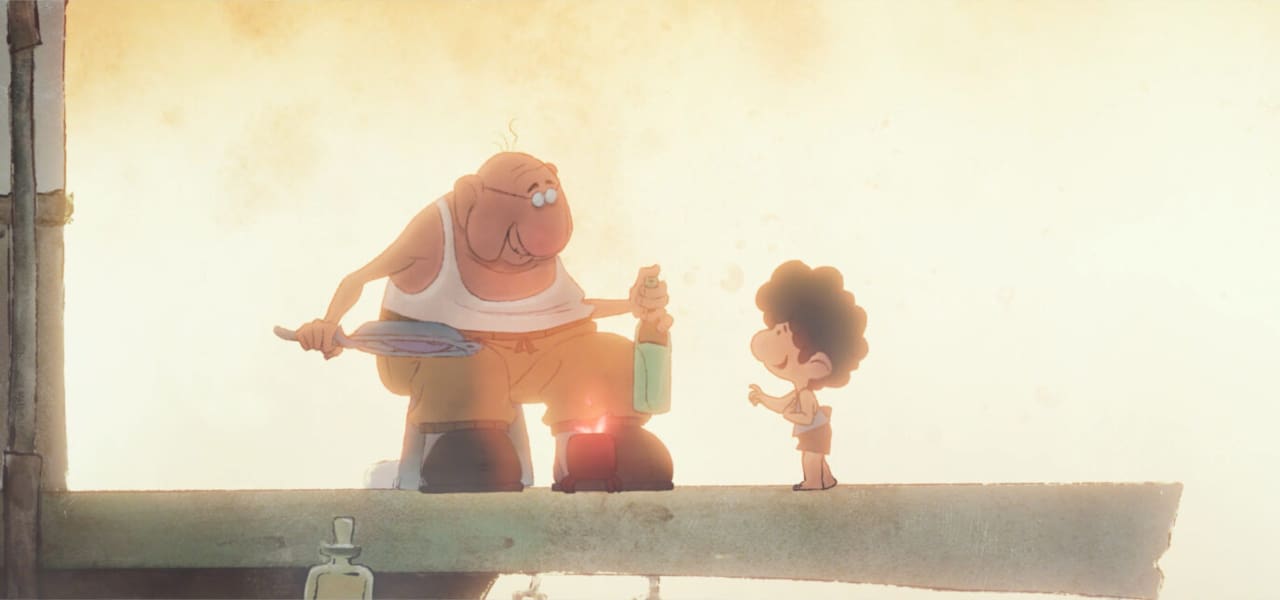
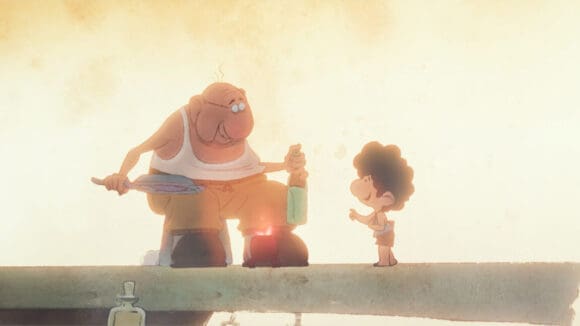
Today’s short is DreamWorks veteran Liron Topaz’s Saba, a hand-drawn film produced by Lirit Rosenzweig Topaz and told in one continuous shot. Its international animation team includes James Baxter, Tim Watts, Matt Williames, Maël Gourmelen, and Sandro Cleuzo. The film qualified for Oscar consideration through a theatrical run and recently won Best Animated Short at the Woodstock Film Festival.
In a world where living things remain grounded while everything else floats upward, a boy and his grandfather share a home secured by ropes. When a violent storm disrupts their life together, the boy begins a journey toward understanding loss. Inspired by Topaz’s relationship with his own grandfather, Saba turns gravity and the instinct to hold on into physical expressions of grief, memory, and the longing for one more moment with someone we love.
Cartoon Brew: What was it about this story or concept that connected with you and compelled you to direct the film?
Liron Topaz: The story came from something very personal. My grandfather was one of the people who shaped who I am, and losing him left me with this unresolved need for closure. I didn’t want to recreate specific events from our lives, but rather explore what those moments meant to me emotionally. Once I found the concept of a world where gravity became a metaphor for our temporary time here, I felt I finally had the visual language I had been searching for. It gave me a way to talk about grief, memory, and that desire for one more moment without being literal.
What did you learn through the experience of making this film, either production-wise, filmmaking-wise, creatively, or about the subject matter?
I learned how important it is to trust the emotional core of a film, especially when the process becomes technically complicated. The entire film is one continuous shot, for around 14,000 frames. Animators from different countries in various time zones, and a pipeline that required every section to connect seamlessly to the next. It would have been very easy to let the technical challenge become the focus. I kept coming back to the question of why we were making each choice. The biggest lesson for me was that complexity only matters if, in the end, the audience simply feels something.
Can you describe how you developed your visual approach to the film? Why did you settle on this style and technique?
From the very beginning, I wanted the film to feel handmade and intimate, so hand-drawn animation felt like the natural choice. There is something human and imperfect about a drawing that felt right for a story about memory and loss. My biggest inspirations were Michael Dudok de Wit and Mark Baker. They both have a beautiful, simple visual language, and I wanted to capture that charm. I also wanted the camera to feel physical and immersive, as if we were experiencing the journey alongside the characters in real time. That led to telling the entire film without a single cut.
Gravity and the characters’ need to remain tethered are such fundamental rules of the film’s world. How did you decide what those rules would be, and how strictly did you adhere to them while developing the story?
The rule was always very simple: everything living remains grounded, while everything that is not begins floating upward toward the other side. Once we established that, we tried to follow it very strictly because I wanted the world to feel believable, even though it was surreal.
The ropes became a physical expression of our instinct to hold on after loss, to keep the people, memories, and moments we love from drifting away, even when we know we eventually have to let go. Nothing in the film was arbitrary. Every detail carried meaning, either connected to something personal from my life or to the poetic ideas the film explores.