2027 Oscars Short Film Contenders: ‘Soul Catcher’ Directors Amanda Strong And Pamela Post
Stay informed with free updates
Sign up to get our news digest — delivered directly to your inbox twice a week.
Welcome to Cartoon Brew’s series of spotlights focusing on the animated shorts that have qualified for the 2027 Oscars. The films in this series have qualified through one of multiple routes: by winning an Oscar-qualifying award at a film festival, by exhibiting theatrically, or by winning a Student Academy Award.
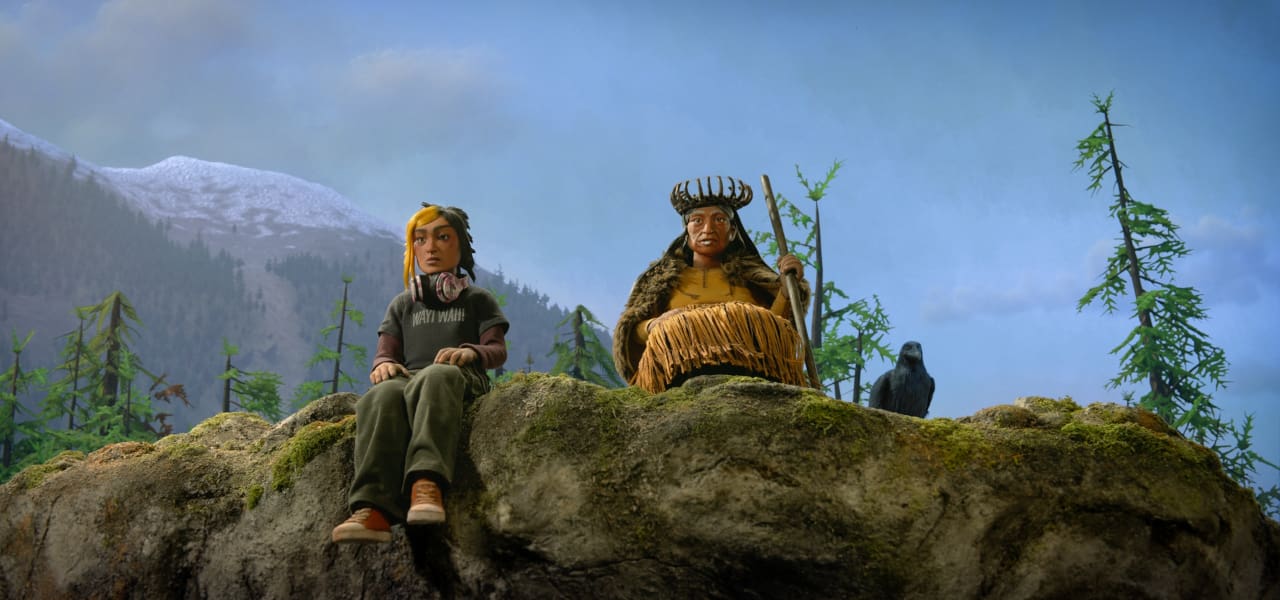
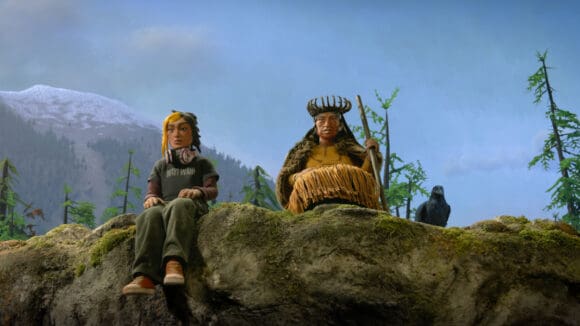
Today’s short is Haboolm Ksinaałgat (Soul Catcher), directed by Amanda Strong with co-director and screenwriter Pamela Post, and made independently through Spotted Fawn Productions. The Canadian film combines stop-motion puppets and physical sets with CG effects, executed across a five-year production. After its world premiere at TIFF, it qualified for Oscar consideration by winning the animation Grand Jury Award at the Edmonton International Film Festival.
Based on an incident from Post’s father’s childhood, the film follows a young Ts’msyen apprentice on a supernatural journey along the Ksyen, or Skeena River. An act of cruelty by a missionary becomes the starting point for a story of cultural reclamation and intergenerational healing. The filmmakers worked with First Nation artists to design the totem poles, creating digital models and hand-painted physical versions that could move between the production’s animation techniques.
Cartoon Brew: What was it about this story or concept that connected with you and compelled you to direct the film?
Pamela Post: Soul Catcher is based on a true story from my Ts’msyen father’s childhood. He grew up in a tiny village on the Ksyen (Skeena River) in British Columbia. He was a much older dad. His stories were like time travel. I felt in my gut this was meant to be a stop-motion film and was an admirer of Amanda’s powerful work. The film depicts an act of cruelty against my dad and other Ts’msyen children by an old evangelical missionary in the early 20th century. It’s my way of righting that wrong through art.
Amanda Strong: My connection to the story started as a stop-motion mentor to Pamela. The power of Soul Catcher’s truths led to a deeper collaboration of co-direction. Indigenous stories are best told when made by Indigenous people. Our ancestors were calling through us to go on this five-year handmade journey together.
What did you learn through the experience of making this film, either production-wise, filmmaking-wise, creatively, or about the subject matter?
Strong: Narrative sovereignty was integral for Pamela and me. We chose a harder path, producing independently without external production partners, which meant limited access to resources and financial support. Despite production challenges, we’re proud to own our film.
Stop motion is the slowest, most painstaking, and I think most soulful form of animation, especially precious in this era of AI, but it’s expensive and a lot of work. It’s a constant dance of trying to achieve the highest art with grant dollars that are getting harder to access. Having an amazing team of artists and cast bound to this story was essential to pushing through the creative and technical barriers.
Can you describe how you developed your visual approach to the film? Why did you settle on this style and technique?
Strong: It was important for me to center this film in stop-motion techniques and physically built assets. To represent the vast landscapes, cultural objects, and VFX needs of the story, I knew we needed the aid of 3D. The technical process was a weaving of handmade and digital pieces. We had a lot of new creative challenges we hadn’t faced before. At its core, this hybrid process was the best approach to honoring the stop-motion art form while serving Pamela’s story and community.
Post: The film represents Ts’msyen culture, so centering the story, people, and land was key to its visual representation. From the old shaman’s bear-fur robe and bear-claw crown to the oolichan swimming among the eelgrass in the Skeena River, the monumental totem poles, and sacred rattles, the film is a kaleidoscope of our culture.
How did you approach bringing the century-old totem pole to life through stop motion, particularly given its spiritual and cultural significance?
Post: From a story perspective, my father’s words guided me. Because harm was done to a totem pole, and to my dad as a child, the injured totem pole became a metaphor for the harms of colonization. Returning it to its place of honor is a metaphor for cultural revitalization.
Strong: As a production studio, there are protocols we follow when making films with Indigenous stories and cultural belongings. Museums have a lot of totem poles in their collections, but they’re connected to families and have stories that can’t be copied. We collaborated with First Nation artists to design authentic poles in 2D, with a front and side view, and, with their guidance, modeled them in 3D, followed by 3D printing and hand-painting. Because we had both physical assets and 3D models, we realized we could use them interchangeably in our process.