.png)

‘My Melody & Kuromi’ Screenwriter Shuko Nemoto: ‘There’s A Warmth To Its Handmade Quality’
Stay informed with free updates
Sign up to get our news digest — delivered directly to your inbox twice a week.
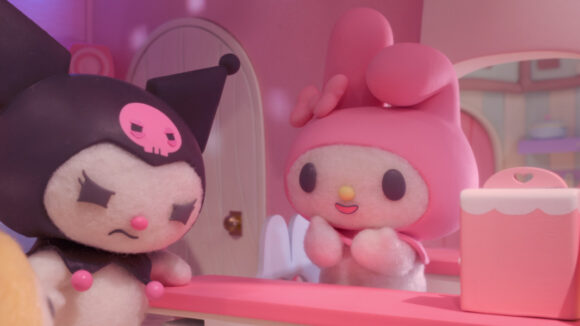
In the pastel-colored world of Mariland, My Melody – a white bunny who wears an eye-catching pink hood – runs a successful cake shop, bringing happiness and cheer to everyone. Well, almost everyone. Kuromi, who runs a Japanese sweet shop across the street, is determined to outdo My Melody’s business venture. Their rivalry heats up as a sweets-making contest kicks off, but strange events are about to unfold in Mariland that may prove distracting.
My Melody & Kuromi is a new Netflix animated series featuring the titular iconic Sanrio characters. Netflix previously collaborated with Sanrio on the live-action/CG animation hybrid Gudetama: An Eggcellent Adventure and the 2D animation Aggretsuko. The streaming service has seen success with stop-motion stories before, with series such as Dwarf Studios’ Rilakkuma & Kaoru, Pokémon Concierge, and its Oscar-winning feature, Guillermo del Toro’s Pinocchio. This time around, Wit Studio’s new stop-motion division, Toruku Studio, takes up the mantle. The Toruku team is headed up by series director Tomoki Misato, a leading young voice in stop-motion who previously created the surreal cult phenomenon Pui Pui Molcar.
Penning the series’ screenplay is veteran playwright Shuko Nemoto. A departure from her usual work, My Melody & Kuromi carries an emotional sensitivity and wisdom far beyond its early-years appearances. Cartoon Brew sat down with Nemoto to discuss the joys and challenges of writing for stop-motion without constraints, and what these beloved Sanrio characters mean to her.
Cartoon Brew: To start us off, could you outline your background in theatre and screenwriting for the benefit of Western readers, who won’t be as familiar with you?
Shuko Nemoto: I’m currently thirty-five years old, and I’ve been writing for theatre since I was nineteen. When I was young, I saw many different types of theatre – plays, musicals, and kabuki. I started out writing theatre with everyday dialogue, but I later branched out to collaborate with musicians in writing musical theatre. Recently, I scripted a play in Japanese for Korean theatre.
How would you define your writing style?
My writing tends to focus on relationships – whether that’s romantic or platonic, or the relationship between family or friends. Even when you’re in a close relationship with someone, it is difficult to completely understand one another, but there’s something interesting or hopeful about that fact.
As with the writers of some of Netflix’s other stop-motion efforts, your previous screenwriting is not in animation. How did you come to be involved with this series?
I got an offer from the production company. A member of the company’s board happened to see one of my plays, and they thought that the world of My Melody and my writing could align well.
When they came to you with that offer, could you immediately see why they thought that?
I’ve loved Sanrio since I was a kid, and My Melody happened to be my favorite character of all. So I was really happy to get the offer. I never thought I’d get the opportunity to write for Sanrio characters. But I’d never written a screenplay for an animated project before, so I was a bit confused, and I had to make sure that I was the right fit.
What do you feel is the essence of these two characters, My Melody and Kuromi?
It’s well known that there’s a bit of a rivalry between these two characters. To bring this into real life, we all have a part of My Melody and a part of Kuromi in ourselves. Just like My Melody, we try to enjoy everything a bit nonchalantly. On the other hand, we have Kuromi, who tends to be a bit jealous. But when these two contrasting personalities come together, they kind of complement each other. I tried to depict this pair as being two halves of a whole.
Sanrio provided detailed information on the characters’ worldviews and personalities, but it was important to somewhat put aside the specifics of My Melody and Kuromi being the characters. I usually write dialogue for human characters, and I tried to occupy that same mindset when writing this series. My Melody and Kuromi each have their own sayings, of course, and I made sure my work matched those, but I think my ability to not be overly influenced by the characters is why I was selected for this project.
Sanrio has a passionate fan base. Did you feel nervous about taking these characters in unexpected directions?
I took time to pitch to everyone and think about the writing process. The director, Tomoki Misato, makes many works that have a horror-esque inflection. We had a meeting at the beginning of the writing process. He showed me a set of five image boards of what he wanted to depict in the animated series. One was My Melody and Kuromi flying in airplanes. The second was the heart being captured by swans. The third was a car chase. The fourth was the opening of the cake shop. And the last one was the Cloud Kingdom in the sky. He also had an image board of the characters from the town going a bit rogue. Looking at those image boards, I was a bit confused. How was I going to depict all of this as a screenplay
Sanrio fans tend to prefer something cute. I tried to respect that and create this screenplay a bit more delicately. I feel like WIT Studio and Netflix offered me this role because they were expecting me to write in a way that is unconstrained by boundaries. We had a lot of meetings with the creative board in trying to pay respect to the characters, but equally, I tried to be a bit genre-breaking. As a screenwriter, I think I was able to fulfill that role well. It was a great honor to be involved in this challenging project.
When working with Director Misato on the project, did you write the scripts after seeing the image boards, with him then using those scripts to create the episodes? Or was it a more collaborative, back-and-forth process from start to finish?
The creative process was mostly completed separately. At the start, I wasn’t familiar with stop-motion animation at all. This car chase scene – if I were in the director’s shoes, I would have thought to omit that, because it’s really hard to execute something like that in stop-motion. But Director Misato is the kind of person who really wants to do something, even if it will take a lot of time and effort. He’s really passionate in that respect.
Essentially, I put together detailed screenplays for the first three episodes based on what Director Misato presented to me during that meeting. Once the screenplay was ready, I introduced the team to what I had in mind for the later part of the series.
Animation, of course, opens up infinite imaginative possibilities for screenwriting – but with stop-motion specifically, you have to make sure that what you write is actually achievable by the artists. How mindful were you of those limitations?
Director Misato was passionate about doing something that had never been achieved in stop-motion animation before. He asked me to write whilst forgetting about the fact that this is a stop-motion animation – to just write like I would for theatre. Which I did – but during the meeting discussing the screenplay for the first three episodes, we discovered that the amount of dialogue was too large to be achieved with the stop-motion mouth movement of the characters. So we did have to adjust the amount of dialogue. I also tried to make the storyline more emotionally dynamic, so that we could see the emotions of these characters change immediately. At one moment, they’re very happy, the next they’re very angry, and at the next moment, they are sleepy and just go to bed. I felt like that could match the style that Director Misato was hoping for.
Having now worked on this stop-motion project and seen the finished results, what excites you about stop-motion as a medium?
I find stop-motion fascinating. In the stop-motion animation that I saw as a kid, the movements were focused on the main characters, or the characters that are speaking the dialogue. But in My Melody & Kuromi, if you pay attention and look closely, you’ll see that the flowers, the animals, and the background characters are also very actively moving. This is a project where an unbelievable number of animals and objects are moving at the same time.
I think you can feel how hard the creative process is when you see this series, and the persistence that goes into that. I’m very happy that there are directors like Misato-san, who are passionate about projects like this. You can feel that passion in this project – there’s a warmth to its handmade quality. There are many fascinating parts to Japanese animation, but I feel like this project could add something new and different to it. I’m very proud of it.
What do you want the viewers of this series to take away from watching it, whether that’s a message, a feeling, or anything at all that comes to mind?
In terms of emotion, I just want the audience to feel warm. It would be great if this series becomes something that cheers them up for tomorrow’s work or school.
In terms of a message, I feel that My Melody and Kuromi are depicted in the series as two strong female characters from two different angles. Stories depicting strong female characters have become trendy in the world these days, but what I find fascinating about these two characters is that their strength is not complete from the beginning. They are actually very weak – feeble – but they own something very strong in the core of their minds. There are many moments in the series where My Melody brims with tears, but there are very few moments where those tears actually overflow. I want the audience to see something courageous in these two characters, who face these challenges even though they’re a bit weak, and in doing so own this true strength in their core.x
With thanks to Yuki Fujiwara for translating.