.png)
Raphael Bob-Waksberg On ‘Long Story Short,’ Satire Without Cynicism, And Giving Shows Time To Grow
Stay informed with free updates
Sign up to get our news digest — delivered directly to your inbox twice a week.
Long Story Short, the latest adult animated comedy from BoJack Horseman creator Raphael Bob-Waksberg, premiered on Netflix in August 2025 and was renewed for a second season before the first episode had even aired (although it had screened for critics, who were overwhelmingly high on the show).
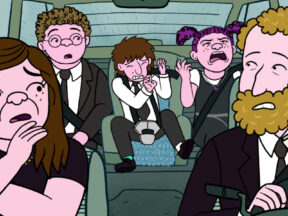
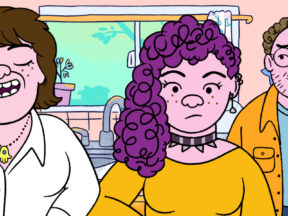
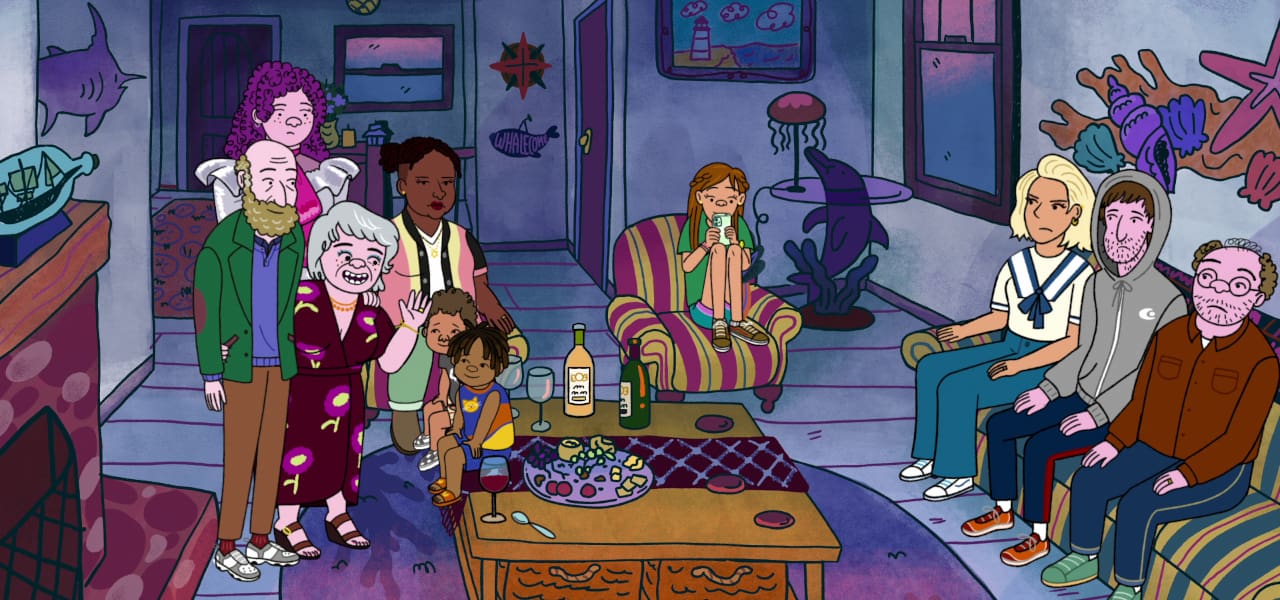
Reuniting much of the BoJack team, including supervising producer and production designer Lisa Hanawalt, the series follows the Schwooper siblings (voiced by Ben Feldman, Abbi Jacobson, and Max Greenfield) across a lifetime, leaping back and forth through the decades to chronicle the triumphs, disappointments, joys, compromises, and tragedies of one middle-class, West Coast Jewish family.
We caught up with Bob-Waksberg ahead of the show’s one-year Annecy world premiere anniversary to talk about making something this personal, why animation’s slow pace is a gift, and the satire lessons he carried over from BoJack.
Cartoon Brew: This show feels more personal than your earlier work, drawn from your own life and your own neighborhood. What’s it like to put that much of yourself into something and then send it out into the world?
Raphael Bob-Waksberg: I don’t think that’s unique to this show. I feel like I dump so much of myself into everything. I can see how this might seem more personal, although people who watched BoJack felt that show was very personal too. I don’t see either project as autobiographical, but certainly personal. Everything I put out has some risk to it, because I mean it. I try to make shows that are fun and entertaining and beautiful, and that mean something to people. And when you do that, it’s inherently vulnerable, because you’re risking a rejection that’s going to feel personal. They’re rejecting the things you think are personally important. So I feel very chuffed, and I hope I’m using that correctly [laughing], by the reaction. It feels like people are picking up what I’m putting down, and it’s still growing.
It’s one of the best portrayals of the COVID era I’ve seen. What did the longer production required for animation mean when showing something that specific in time?
I think that actually helped us. It’s very hard to describe the moment you’re in. The few years that passed from the height of COVID to when we started conceptualizing the show let us be deliberate in a way the shows in production during the height of it couldn’t be. We could wrap our heads around what we wanted to say. What was this moment, and what’s the moment we’re still in, but in a different way? That takes time, and animation is good about that, because animation also takes time. Unless you’re South Park and you knock them out, you have to be more thoughtful about the stories you tell.
I remember, going back to BoJack, we had an episode I really wanted to do about Bill Cosby. I thought, ” Why is nobody talking about this? He’s about to do a big special at Netflix.” And my execs had a note: “Can you make this feel a little less specifically Bill Cosby?” I was whatever the opposite of chuffed is, because I assumed it was because he was doing a special with them. So we changed a bunch of the details. Then, during production, suddenly everyone did start talking about Bill Cosby. It was everywhere, and by the time the episode came out, it wasn’t breaking news at all, and I was so relieved we’d obscured it enough to make it a broader point.
I was uncharitable; I thought they were just covering themselves. The truth was, they saw what I couldn’t, that it would have more resonance if it didn’t feel tied to one specific moment. Now, when I think about satire, I ask, “Am I still going to find this interesting a year from now? What’s a way to make it feel evergreen, instead of just reacting to the current moment?”
Your shows go to dark and edgy places, often poking fun at buzzy topics, but it never feels like trolling. How do you think about that line?
I won’t comment on other shows. But for myself, I got bored very quickly of that “Ain’t I a stinker?” energy on BoJack. Can you believe I’m saying this, can you believe I’m getting away with this? There was a thrill to it, and you can see it in the first season of BoJack. At the beginning, it was “Okay, what can I get away with? When are they going to tell me to stop?” I realized very quickly they weren’t going to, and I thought, I need some self-control, because they’re going to let me do whatever I want. So now that I know that, what do I actually want to say?
Some jokes out there are mean for the sake of being mean, and I don’t think that’s that interesting. With BoJack, there was something fun about, oh, let’s do an episode about abortion, but what do we actually want to say about it, not just a bunch of tee-hee? There’s even less of that on Long Story Short. Because we’re in a more grounded world, some of our characters’ behavior feels more outrageous in the context of the real world. A single move can get a gasp just because the audience knows these characters, whereas in a broader, heightened setting, it wouldn’t even register.
It also looks nothing like BoJack, at a time when many series from similar teams seem to want to look similar, almost relying on visual fidelity. From the outside it looks kind of brave. Was that departure a deliberate choice?
I don’t think it was a brave choice on our part. Maybe on the part of the studio that didn’t push back against it. For me, and I think for Lisa [Hanawalt], it was the opposite, an opportunity to do something a little different. It was a priority from the start. How do we make this not feel like it’s just BoJack or Tuca & Bertie? I wanted to work with Lisa because she’s brilliant and I know her range, so I never doubted it would look different while still keeping some of the warmth. When we started BoJack, we were both new to TV animation, learning the rules. Ten years later, we have the confidence to break some of them, and to bring much more of our own taste into the process.
Is this a world you can keep returning to? There used to be a sense that streaming shows were cursed after about three seasons.
That’s not a curse. That’s people at studios making decisions. My experience with BoJack was that it grew over time; every season was bigger than the last, and I think it’s now bigger than it was when it got canceled. I’d hope Netflix heeds that lesson and gives this show time to grow. If they’re looking for the next BoJack, they can’t assume the initial numbers are indicative of the heights it can reach. I’ll say that to anyone who’ll listen, though I’m not sure anyone’s listening.
As for me, I’ll keep making it as long as they let me. This is a very deep world, and these characters and relationships are complicated and interesting. Maybe at some point I’ll get bored, but for now I feel like we’re just at the beginning.