From Animation School to the Real World

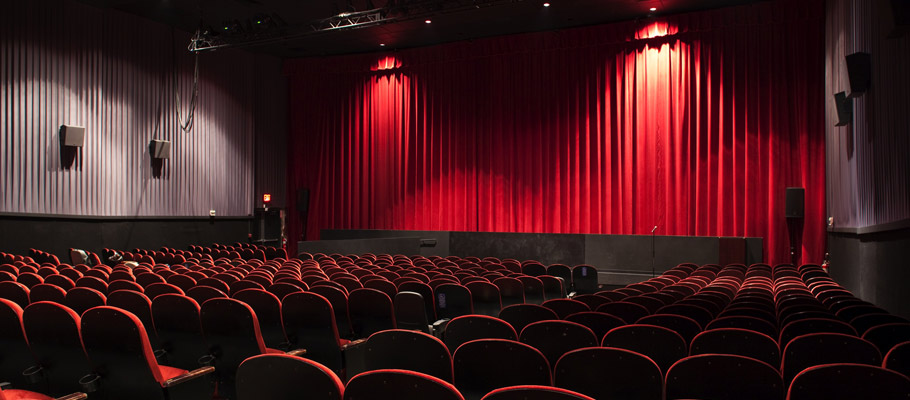
Last week, I flew out from Los Angeles to New York to attend the annual Dusty animation screening at the School of Visual Arts. I watched forty thesis films from this year’s graduating class—a very solid year, I might add—and witnessed many of the students experience pre-show jitters and post-show relief. It was a fun night getting to see a lot of my old classmates, friends and teachers again, but most importantly it made me reflect on my own experiences since my own thesis screening two years ago.

While graduation was a big deal, the thesis screening was really the big night for us. The films we put a year’s worth of blood, sweat and tears into were going to be shown in front of an audience on the big screen, and for most of us, that was a completely new experience. Some of us felt that our thesis films were like big flashy business cards or “HIRE ME” signs, so if there were any industry people in the audience that night, it just might be the ticket to having a job lined up after graduation.

A few days later at the Dusty Awards ceremony, my film ended up winning the Outstanding Traditional Animation award (tied with my friend Zach Bellissimo’s Blenderstein, which was featured here on Cartoon Brew), so in a way I felt validated that I was a decent enough animator to go out and make a living after I left school.

There were times that I felt my future was uncertain, and that having a career in this field might not work out for me.

But after college, the excitement of working as a professional animator gradually began to fade. I went through many ups and downs (mostly downs). I had long periods of busy work, and even longer periods of unemployment. And some of the jobs I had, while keeping me busy, barely supported me. There were times that I felt my future was uncertain, and that having a career in this field might not work out for me. I became disenchanted with the medium, felt emasculated by my peers and started falling into a depression. And seeing a lot of my friends and classmates in equally dire straights filled me with even more trepidation about my career path.

After dealing with this for over a year, I finally made a very big decision to pull up stakes, leave New York and move to LA. It was risky because I didn’t have a job lined up for me when I came out here. Luckily I had friends who found a place for me to live and I got a job in the industry almost immediately upon arrival. Even though I’ve been in LA for only three months, I consider it the best decision I’ve ever made. I feel like I’m in an environment where creativity and appreciation for the craft is never-ending, and I’m the happiest I’ve been since I graduated two years ago.

Be hopeful, hone your craft, push yourself out there, and eventually you will find your place.

And being back at the SVA Theatre watching these incredibly talented young animators go through the same reactions and emotions filled me with both excitement and concern. These students, as well as the hundreds upon hundreds of other graduates coming out of animation schools all over the country, will be put through the same paces as myself. After graduation, that safety net of college life is gone, and despite what your professors or friends tell you, nothing can really prepare you for what happens after you graduate. But the important thing that I want to express to these soon-to-be professional animators is to be hopeful, hone your craft, push yourself out there, and eventually you will find your place.

Don’t let ANYONE or ANYTHING disenchant you. Everybody goes through these motions at one time or another after leaving school. Some of you might have jobs lined up right after school, and some of you might have to wait a little longer. It’s a very scary thing to go through, but it’s all part of the experience. You appreciate things more when you experience the bad alongside the good. It’s something you learn from, and carry with you for the rest of your life. Never wait for opportunities to come along, but instead seek them out. It’s different for everyone. I had to move from one coast to the other to find what I wanted, and I’m glad I did. Keep doing personal work, develop your skills up and surround yourself with people who love and support you and what you do. If you do that, everything will be okay.

With that, I want to congratulate and wish the best of luck to all the recent and soon-to-be graduating animation students. Don’t let employment statistics fool you. The world is chock full of opportunities waiting for you to snatch up. So go out there and keep this industry alive and thriving!

Oreo “Wonderfilled Anthem” Directed by Martin Allais

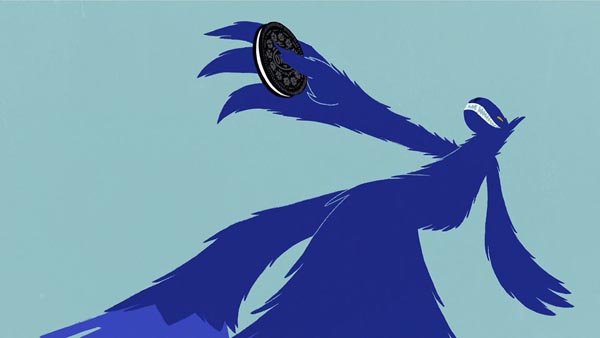
If there’s anything that can both dazzle my senses and make me crave Oreos, it’s this 90-second animation for Oreo’s new “Wonderfilled” campaign, directed by Martin Allais and his production company Studio Animal. Animated to a jaunty tune performed by Owl City, the spot is filled with wonderfully stylized animation, a fantastic sense of design, fun transitions, and eye-popping colors from beginning to end. And much like the classic commercials of yesteryear, it makes me WANT to buy the product it’s selling.

CREDITS
Global Marketing Communication:  Jill Baskin
Brand Marketing Director: Janda Lukin

Agency Credits
Chief Creative Officer: Joe Alexander
Group Creative Director: Jorge Calleja
Creative Director: David Muhlenfeld
Creative Director: Magnus Hierta
Senior Art Director: Brig White
Planning Director: John Gibson
Managing Director: Steve Humble
Senior Broadcast Producer: Kathy Lippincott
Broadcast Producer: Heather Tanton
Broadcast Junior Producer: Caroline Helms

Production Company: Studio Animal
Director: Martin Allais
Producer: Maria Soler Chopo
Illustration: Martin Allais
Storyboards: Martin Allais
Animatic: Pere Hernández, Javi Vaquero, Matt Deans
Animator: Pere Hernández, Javi Vaquero, Pablo Navarro, Dani Alcaraz
Tracing and color:Ezequiel Cruz, Macarena Ortega, Eva Puyuelo, Joel Morales
Compositing: Santi Justribó Martin Allais

Music
Music (performed by): Owl City (Adam Young)
Voiceover talent: Owl City (Adam Young)
Original Music and Lyrics: David Muhlenfeld (English Major, LLC)

Fred Moore and the Moving Silhouette

Among the most important things an animator must keep in mind when animating is making sure that drawings read clearly to the viewer. By using strong keys, solid staging, and clear silhouettes, the audience can understand the actions that a character performs onscreen.

Legendary Disney animator Fred Moore, known for his broad yet overwhelmingly appealing drawings, took that idea one step further in his animation. Not only did he have strong silhouettes in his keys, but he ensured that his animation had strong silhouettes throughout a scene. The clarity of his silhouettes remained even in the breakdowns and inbetweens.

In this scene from Pluto’s Judgement Day, Moore animates Mickey struggling to regain order after Pluto, covered in mud, chases a kitten into his house and wrecks havoc:

Despite how frantically Mickey is moving around in this shot, as well as being obscured by Pluto and the mud effects, his action is still clear because Moore kept the silhouettes intact from drawing to drawing for most of the scene. The negative space between Mickey’s limbs, head and ears as well as the kitten’s paws, ears and tail help bring out the poses. Further, he exaggerates his poses for readability, especially during anticipations. Moore also uses strong arcs, both in Mickey’s torso and his arms, to visually guide the viewer where the actions is going next.

I went over the whole scene and blacked out Mickey and the kitten to show their silhouettes more clearly:

Disney story artist Mark Kennedy talks about silhouettes in greater detail on his blog.

5 Reasons Why Mickey Mouse Co-Creator Ub Iwerks Was Awesome

Most animation fans know that Ub Iwerks co-created Mickey Mouse. But he contributed a lot more to animation than people think.

1. Ub Iwerks was a workhorse


While the rest of Disney’s studio was toiling away on the last few “Oswald the Lucky Rabbit” shorts that they were contractually obligated to finish for Universal, Ub animated the first Mickey Mouse cartoon, Plane Crazy, alone and in complete secrecy. During work hours, Ub would place dummy drawings of Oswald on top of his Mickey drawings so nobody would know what he was doing. At night, Ub would stay late and animate on Mickey. He animated the entire six-minute short singlehandedly in just a few weeks, reportedly averaging between 600-700 drawings a night, an astounding feat that hasn’t been matched since. When the success of Mickey Mouse propelled the Disney studio to new heights, Ub continued his efficient streak by animating extensive footage on Silly Symphonies shorts like The Skeleton Dance and Hell’s Bells.

2. Ub Iwerks was a mechanical marvel


When not animating with a pencil, Ub loved to build and create inventions. He was intrigued by the inner workings and mechanics of machines, and loved to delve into what made things work. Supposedly he once dismantled his car and reassembled it over the course of a weekend. With this mechanical knowhow, Ub invented devices that incorporated new techniques into his cartoons. After Iwerks opened the Iwerks Studio in 1930, he heard that Disney was attempting to develop what later became the multiplane camera. Ub one-upped his old partner and made his own version from car parts and scrap metal, and incorporated the multilane technique into his cartoons, like The Valiant Tailor:

3. Ub Iwerks was a jack of all trades, and a master of every one


Besides being a skilled animator, mechanic and machinist, Ub constantly expanded his creative and intellectual pursuits through hobbies and sports. Being the ultimate challenge-seeker, he excelled at every single thing he attempted. And when he felt that he had mastered something and it was no longer a challenge to him, he’d quit. When Ub bowled a perfect 300 game, he put his bowling ball in the closet and never bowled again. When he took up archery, he became such a skilled archer that he got bored of getting bulls-eyes and quit that too. Even as an animator, Ub felt he perfected his craft and after his studio closed in the mid-1930s, he never animated again.

4. Ub Iwerks created movie magic


When Ub rejoined the Disney studio in 1940, Walt Disney gave his old partner free reign to do as he wished. With Disney’s resources, Ub developed special effects techniques for animation, live-action films and Disney’s theme parks, much of which is still in use today. He helped develop the sodium vapor process for live-action/animation combination and traveling mattes, which he won an Oscar for in 1965 after utilizing it in Mary Poppins. He adapted the Xerox process for animation, which eliminated the tedious task of hand inking every cel. For Disneyland, Ub designed and developed concepts for many of the park’s attractions, including the illusions in The Haunted Mansion and the animatronics for attractions like Great Moments with Mr. Lincoln and Pirates of the Caribbean. Disney even loaned him out to Alfred Hitchcock to help with the effects needed to create flocks of attacking birds in The Birds.

5. Ub Iwerks made animation what it is today


If Winsor McCay laid he foundation for character animation, then Ub Iwerks built a castle on top of it. He took the didactic rigidness of what animation was in his era and made it loose, organic, appealing and fun. Building upon what Otto Messmer did before him with Felix the Cat, the characters Ub animated were packed with personality. Characters like Oswald the Lucky Rabbit and Mickey Mouse were creations that audiences could relate to as no characters before. They thought, breathed, emoted and were infused with life.

What Iwerks designed and animated in shorts like Steamboat Willie and Skeleton Dance contained the principles (squash and stretch, appeal, anticipation, etc.) that became the genesis of the “Disney style”, which animators like Fred Moore, Norm Ferguson, and Milt Kahl later fleshed out. His work reached out and influenced animators all over the world, and they took the ball and ran with it. Rudolph Ising and Hugh Harman, who worked under Ub at Disney, brought his sensibilities to Warner Bros. and developed the Merrie Melodies and Looney Tunes series. Many animators got their start at Ub’s studio in the early 1930s, including UPA co-founder Steve Bosustow and Warner Bros. director Chuck Jones. Manga and anime pioneer Osama Tezuka was also greatly influenced and inspired by Ub’s work.

To learn more about Iwerks’ life and work, read the biography The Hand Behind the Mouse.

The Milt Kahl Head Swaggle

Like a signature, each animator has their own little quirks or trademarks that distinguish their animation from others. Some draw character’s features in a unique way (eyes, hands, etc.), some lean heavily on certain principles or include abstract imagery or gimmicks into their scenes, and some fall back on specific poses or gestures. The “Milt Kahl Head Swaggle” is an example of the latter, and it both intrigues and aggravates me at the same time.

To clarify, the “Milt Kahl Head Swaggle” is when a character (animated by Disney legend Milt Kahl) sort of rattles his/her head from side to side, usually at times when they’re feeling cocky or self-assured. Sort of an “Am I great or what?” type of gesture.

Again, I can’t deny how remarkable an animator Milt Kahl was, but for a long time I considered him to be a really hammy animator in the worst possible sense, and this gesture helped cement that idea for me.

In a Frank Thomas or Ollie Johnston scene, I could see the wheels turn in a character’s head and felt that the characters were sincere, emotionally-driven personalities. I never felt that in the majority of Kahl’s characters. A lot of his characters are like actors on a stage, projecting themselves a bit too far in their performances.

But at the same time, he uses this gesture for a reason, and it works well in every scene he implements it. He only used it on broader, more caricatured characters like Tigger, Sir Ector or Brer Rabbit, characters with strong egos and a cocky sensibility, and the gesture defines the character’s personality in the most simple and direct way possible.

Much like finding an often-reused piece of animation or sound effect in a Disney film, my dislike for it came only from repeated viewings. Because we live in the age of DVDs, Netflix and Quicktime files,  we now can have a studio’s entire library literally at our fingertips, able to survey and dissect the content any way we choose, including surveying an animator’s entire forty-year output front to back and taking shots completely out of context like I have here.

Another thing I realized over time is that Kahl seemed to prefer being a broader animator. For years he was stuck with the most difficult and seemingly less interesting assignments, which the rest of the animators couldn’t pull off because they weren’t as good of a draftsman as him. For example, he clamored to work on characters like Captain Hook but was stuck doing Peter Pan and the Darling children, or he was saddled with Alice instead of the more zany, off-the wall characters that populate the rest of Alice and Wonderland. He would end up designing a lot of these other characters, but never get to animate most of them.

Luckily for him, by the 1960s, Kahl’s creative shackles were loosened and he was back to doing broader animation. He went all out on each assignment from The Sword in the Stone through The Rescuers. Each character he animated during this period overflowed with energy, all of which was probably pent up inside of him for so many years. His days of princes and realistic little children were over, and for the rest of his career he was able to let loose, have fun and do the things he wanted to do.

Milt Kahl knew he was a good animator, and he wasn’t afraid to show it through brash flourishes of animation. The head swaggle, corny and over-the-top though it may be, not only defines those Disney characters, but also defines the self-assured Kahl himself.

Walt Kelly’s Even-More-Lost “Pogo” Storyboard

Here’s a little added-bonus to the recent post about Walt Kelly’s self-animated Pogo short.. Before he began animating, Walt Kelly laid out a complete storyboard of his planned Pogo special. He then made a Leica reel and recorded his voice over it.

Of course, there is a lot more here then what ended up in the final short. Because of his poor health, he had to leave out a great deal of material. Sadly, it makes the final piece feel unfinished.  Albert’s hallucination sequence especially would have been marvelous to see fleshed out in animation. Fortunately, not all of his hard work went to waste. His storyboard for this special laid the foundation for his final Pogo book, Pogo: We Have Met the Enemy and He Is Us.

As much as I love seeing Kelly’s animation, watching and listening to the storyboard is a much more enjoyable experience. His storyboard panels have as much time and care put into them as his comics, with full color, fleshed-out poses and backgrounds. Each panel is expertly laid out, making every action clear and easy to read.

But I think the most enjoyable aspect is Kelly’s mostly ad-libbed narration. You can tell what kind of person he was just by his vocal delivery. At times he’s full of bravado, belting out lines in a bombastic tone. Other times he can be soft-spoken, sincere and passionately poetic. And sometimes he makes absolutely no sense at all, talking in almost complete gibberish, fumbling over words and mumbling nonsensical sounds. Most of all, what stands out is his unparalleled wit, which is on display throughout the entire 25-minute presentation. I especially love his impromptu descriptions of scene transitions and camera movements.

With this storyboard, Walt Kelly has come full circle. Starting at Disney in the mid-30s, working for five years refining and strengthening his drawing abilities, leaving animation to pursue a lengthy career in comics, and finally returning to animation once again, this time with the added benefit of decades of experience.

Analyzing My Favorite Piece of Animation: Tigger by Milt Kahl

Sometimes when I’m animating, I recharge my creative batteries by watching some of my favorite scenes or pieces of animation. There’s a handful of animated pieces that I watch again and again, but only one that I always return to without fail. It blows me away every time I see it, and upon each viewing, I always seem to discover something new. After every viewing, it makes me strive harder and harder to become a better animator.

No surprise that this scene from Winnie the Pooh and the Blustery Day (1968) is a Milt Kahl scene. I may be one of the very few people who has had the gall to say something remotely negative about Kahl’s animation in the past, but I still think all the admiration for him and his work is completely justified. He could handle anything, and make it look and move beautifully. It’s a shame he wasn’t given more assignments like this one, because I feel that his more cartoon-oriented animation really stands out as some of his best.

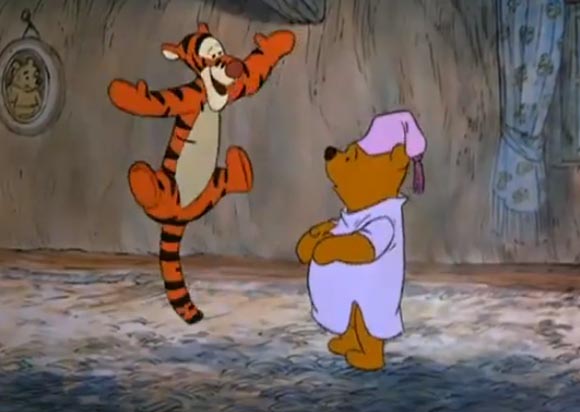
While the entire four-minute sequence of Tigger in Pooh’s house is wonderful (great personality animation, dialogue, pacing, etc.), it’s the shot of Tigger bouncing around Pooh that stands out for me. The reason I love that scene so much is that it perfectly encapsulates all twelve principles of animation. In about 7 seconds, each principle is flawlessly showcased, some multiple times, and some intertwining and overlapping one another. As broad and over the top as it is, there’s layer upon layer of intricate elements that make the scene work.

For starters, watch when Tigger first begins bouncing:

There’s little to no anticipation in his legs, but instead the anticipation is shown in the movement of his head going down before the take off. The tilt of his head, in relation to his arms, legs, ears and whiskers as he first jumps show a great use of arcs. Also notice the successive breaking of the joints on Tigger’s arms, from his shoulders to his elbows to his wrists, and the drag on his fingertips.

As he bounces in place, you can really feel the energy transferring through his body, from his head down to his tail and right back up to his head again, much like a wave action. The folds and wrinkles in his body as he squashes down not only tell us that Tigger is a well-worn toy with loose stuffing, but how much force and weight that Tigger is exerting with each bounce.

Now, Tigger begins to bounce in a circle around Pooh: 

This is why Tigger’s stripes play such an integral role in his design. The stripes sell the idea that Tigger is not a flat drawing, but a three-dimensional living creature. His stripes wrap around the forms of his body and give the illusion of volume. So when Tigger is bouncing around Pooh, those stripes make it clear that Tigger’s body is turning away from us in perspective. Also notice the overlapping action on Tigger’s tail, and how it bends and swings at the kinked parts.

Tigger then jumps up and spins on his tail:

There’s so much going on in this one-second action. Tigger’s torso is twisting and contorting, his top half slightly delayed than his bottom half. Like before, his arms and legs following arcs, and his hands, ears and whiskers are dragging behind. And while all this is going on, he’s squashing and stretching on every bounce until finally easing into his final pose before making physical contact with Pooh and charging offscreen.

And throughout that entire scene, on every bounce, footstep and contact, Tigger is hitting every single beat in the song. Each of Kahl’s key poses are appealing, with clear staging and strong silhouettes. It’s almost contradictory how Tigger moves. While he’s galumphing around the screen like a roughhouse, there’s a certain level of grace in his movements. And both Tigger and Pooh’s personalities are easily distinguishable, Tigger being confident and boisterous and Pooh being underplayed and submissive. Overall, a tour de force of animation.

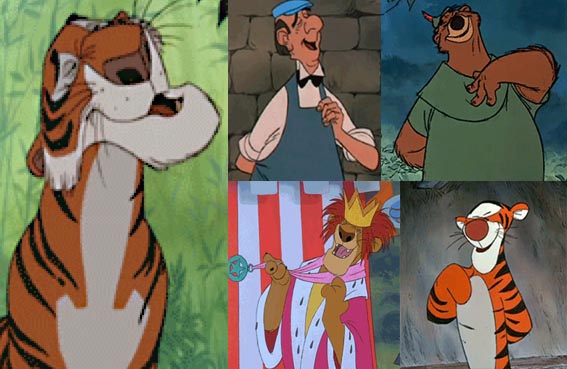
Coincidently, Kahl was also animating Shere Kahn in The Jungle Book around the same time. They’re both tigers (Tigger loosely so), but look how drastically different in approach and execution they are from each other. Shere Kahn is restrained and more subtle—built and functioning like a real tiger, while Tigger is so full of energy and enthusiasm that he’s practically bursting at the seams, and is a completely graphic design. Compare them to Kahl’s caricatured tiger from the Goofy short Tiger Trouble twenty years earlier and you have some sense of how broad Kahl’s abilities were as an animator.

I would’ve loved to know Kahl’s opinion about his own work on Tigger. I know there’s plenty of information floating around about how he felt animating Medusa, Shere Kahn, the Brers and all of his human characters, but barely anything about his work on Tigger. If anyone has any insight about this, please share!

For those that want a closer look at this scene, here’s a video of it slowed down 500% with annotations:

Rediscovering Walt Kelly’s Lost “Pogo” Short

If you want something done right, you have to do it yourself.

Walt Kelly had had a regrettable experience making The Pogo Special Birthday Special (1969) with Chuck Jones.

“How did you ever okay Chuck’s Pogo story?,” Ward Kimball asked Walt Kelly shortly after the special aired on TV. “I didn’t, for Godsake!,” Kelly cried out. “The son of a bitch changed it after our last meeting. That’s not the way I wrote it. He took all the sharpness out of it and put in that sweet, saccharine stuff that Chuck Jones always thinks is Disney, but isn’t.” Kimball, who was dining with Kelly at the Musso & Frank Grill in Hollywood, pressed further. “Who okayed giving the little skunk girl a humanized face?” he asked. Kelly was so angry he couldn’t answer. His face turned red, and he bellowed to the waiter, “Bring me another bourbon!” In Kimball’s words, Kelly wanted “to kill—if not sue—Chuck.”

Shortly after that debacle, Walt Kelly took matters into his own hands and decided to personally animate his popular Pogo characters. With the help of his wife Selby Daley, he planned on creating a fully-animated half-hour special for television, with the characters expressing a strong stance on taking care of the environment. But due to his ill-health, he was able to complete only thirteen minutes of We Have Met the Enemy and He Is Us, which you see below.

The finished portions are absolutely charming and beautifully crafted. Much like his character P.T. Bridgeport, Kelly is a real showman here. Although he hadn’t animated since Dumbo thirty years prior, his animation skills are still top-notch. While the animation can be a bit choppy at times (mostly keys and some breakdowns with no in-betweens), his drawings are solid and appealing with some real flourishes of fluid animation throughout.

The color, though muddy in the existing prints, also appears to be as vibrant as his Sunday pages, and the backgrounds are as intricately detailed as his splash panels, if not more so. And the voices, humorously performed by Kelly himself, fit the tone and mood of his characters.

Besides Winsor McCay, I can’t think of any other mainstream comic artist who animated their comics to such a painstaking degree. While many comic strips have been adapted for film and television before and since, none of them have met or surpassed the charm and quality of the original artist’s work. Here, the animator and the creator is one and the same, and the drawings are pure, unfiltered and straight from the artist’s hand.

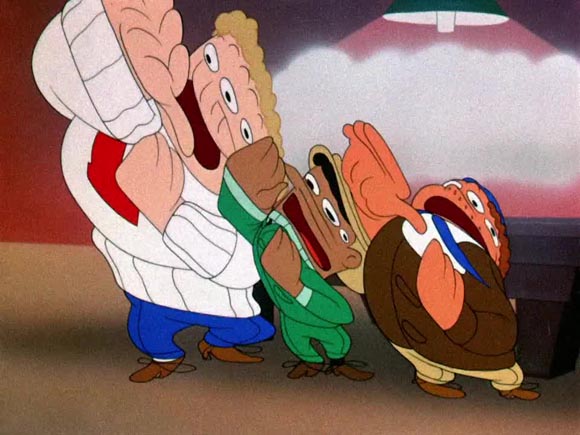
What’s That Crazy Drawing, or How I Came To Know and Love Animation Smears

I didn’t really know about animation smears until college. It was a time when my passion for animation had just kicked into high gear, and once I learned how to convert my DVDs into Quicktime files, the flood gates opened. I was like a kid in a candy store, scouring through hours of animation every day. As I looked through the cartoons, I began to discover some odd things occurring. A character would look perfectly fine in one frame, but for a few frames it would turn into an absolutely insane-looking mutant, before suddenly reverting back to normal form. Without any understanding of what these were, I had discovered smears.

Around the same time, my second year animation teacher at the School of Visual Arts, Celia Bullwinkel, gave an in-class lecture about smears. She explained to us what they were, and what purpose they served. She screened a few smear-heavy Chuck Jones cartoons like The Dover Boys, showed some still-frame examples, and gave us an assignment to animate one ourselves. Of course, every budding animator thinks the same thing when they discover smears: “I CAN USE THESE FOR EVERYTHING!” But soon one learn that smears are best used judiciously; otherwise everything you animate looks like it’s made of Jell-O. 

After some time passed, I began to appreciate smears outside of the context of animation, simply as still pieces of art. Somebody had to draw every one of these. It’s a truly creative and subliminal way of expressing artistic abilities, while at the same time serving the practical purpose of recreating an effect that happens naturally in live-action film.

Eventually, my friends said I should go ahead and make a blog about them, probably so that I would stop pointing them out while we were watching animated films together. So two years ago, I launched Smears, Multiples and Other Animation Gimmicks, never imagining that it would become as popular as it did.

Almost immediately after setting up my first post, followers started pouring in. I opened up submissions so that followers could submit their own images, and people began submitting smears from anime, foreign animated films, television shows, commercials, video games, Newgrounds Flash films, and even smears they had animated themselves. 

As of this writing, the Smears Tumblr has over 110,000 followers. I’m sure many followers simply find the images hilarious, but I believe there are plenty of us out there who think they are much more than just funny images. Either way, I’m glad people get as much of a kick out of these as I do. Perhaps a few young animation fans have been inadvertently enlightened on how much art, creativity and hard work goes into creating animation. That’s a good thing, I think.