.png)
2026 Oscars Short Film Contenders: ‘Cardboard’ Director J.P. Vine
Stay informed with free updates
Sign up to get our news digest — delivered directly to your inbox twice a week.
Welcome to Cartoon Brew’s series of spotlights focusing on the animated shorts that have qualified for the 2026 Oscars. The films in this series have qualified through one of multiple routes: by winning an Oscar-qualifying award at a film festival, by exhibiting theatrically, or by winning a Student Academy Award.
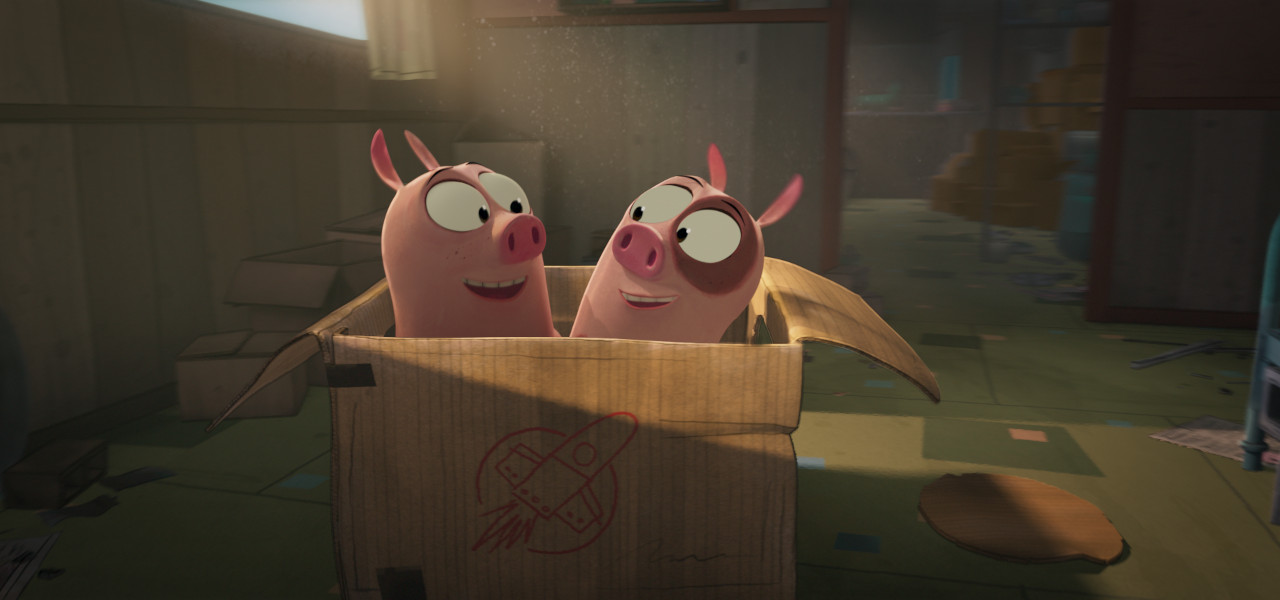
Today’s short is Carboard from director J.P. Vine, produced by Locksmith Animation (Ron’s Gone Wrong, That Christmas), featuring work by DNEG and Ritzy Animation. The film has screened at top festivals including Annecy, Rhode Island, and LA Shorts, and earned its qualification with a theatrical run.
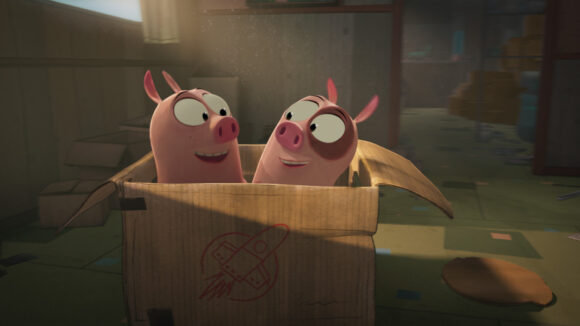
The short tells the story of an overwhelmed single father of two piglets who are forced to move into a rundown trailer park. Without needing any dialogue, it’s clear that he feels like he’s let his kids down, but the imaginative siblings don’t seem to mind one bit and create a fantastic sci-fi universe with just a carboard box and a couple of squirt guns. The short balances a muted, textured realism in the park with vibrant bursts of CG spectacle as the box becomes a spaceship among cardboard stars.
Cartoon Brew: What was it about this story or concept that connected with you and compelled you to direct the film?

J.P. Vine: A road trip across Nevada introduced me to a superb location: the widescreen desert, which was dotted with somewhat forlorn-looking trailer parks. I loved the visuals and started sketching out ideas for a family arriving there – in the process, it fused with memories of my own childhood and our family’s arrival at a fairly rough new home after a period of housing instability. As a kid then, I just got lost in my own imaginative world, but I could sense how tough it was for the family to adapt. Later, as a dad, I thought a lot about the pressure on parents to protect and secure a happy life for their kids, and how often what kids really need is for us to just join in their imaginative universe and see things the way they do.
The story gelled around this theme – that wonder and play can redefine the way we handle change and fear. So the short is about two perspectives colliding with each other: that of a worried dad and of two exuberant kids.

I boarded the short while at Pixar but had to shelve it when I got the opportunity to co-direct Ron’s Gone Wrong for Locksmith Animation. But it never left me. It’s one of those projects that sat on my hard drive and stared back at me, saying, “So? Are you going to get me done or not?”
After numerous false starts, I’m so grateful that Locksmith Animation not only gave the go-ahead but embraced the project as a creative experiment within the studio. With my brilliant producer Michaela Manas Malina, we built a tiny, passionate team to bring it to life.
What did you learn through the experience of making this film, either production-wise, filmmaking-wise, creatively, or about the subject matter?
My biggest takeaway is gratitude. To make a short alone, then be surrounded by a cavalry of talent willing to elevate it at every step, was an absolute joy. We had to be adaptive: we tried making it in 2D, then in Unreal Engine, then found a way to make it in a classic CG pipe with the talents of Ritzy Animation and DNEG Animation.


It taught me a lot about being bloody-minded. Shorts are driven by passion and connection with the story, and putting them together requires a bit of grit, timing, and sticking to instinct. After working on a feature, it was a delight to work with a smaller team who all had skin in the game and were determined to get it over the line, with Locksmith backing us throughout.
Can you describe how you developed your visual approach to the film? Why did you settle on this style/technique?
Coming from theatre design, I always found it helpful to have the “one idea” that underpins the visual approach. For me, Cardboard itself was it: papery, ephemeral – it’s in the piles of boxes that burden Dad, and it triggers opportunity for the piglets.
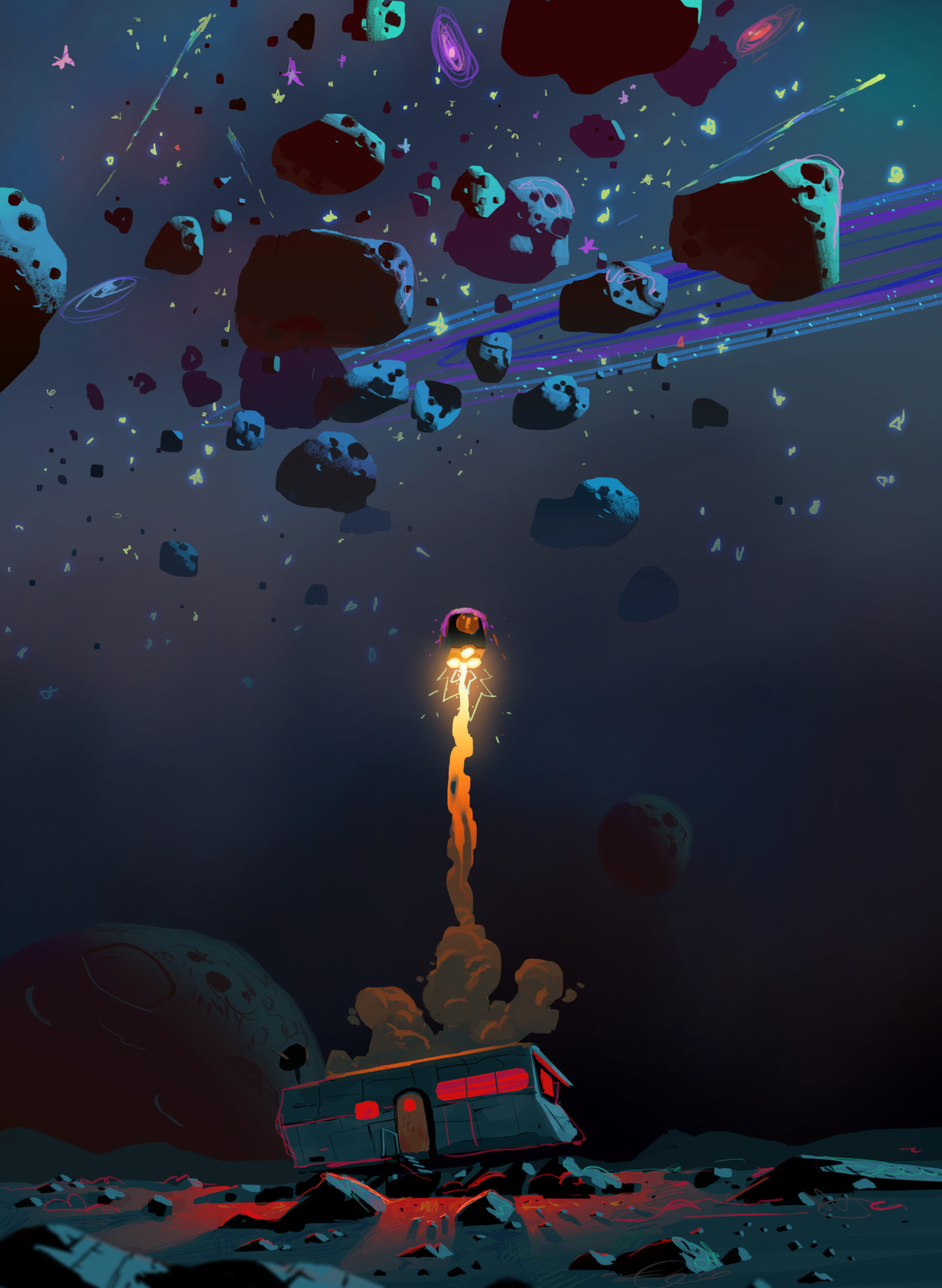
With that in mind, I wanted an illustrative and textural approach throughout. It’s in sync with the way I draw and with the 2D origins of this short. Watercolor also became really important to tie the two worlds of the short together – the dusty, subdued world of the desert and the loose, vibrant space sequences.
No doubt Maurice Noble’s Road Runner art inspired me, fused with a heavy dose of Calvin and Hobbes. The looseness of the brush and linework is there to push an intimate and handmade feel.

The short’s aesthetic feels like an elevated, CG adaptation of marker drawings on cardboard, particularly in some of the action scenes in the imagined action sequences. What techniques did you use to maintain the tactile aesthetic in both the real and imaginary worlds?
We worked hard until it struck the right balance between cinematic and illustrative. Look development was a process of removing the “CG” feel step by step – using cardboard textures in shadows, paper grain, inky contours, and hand-drawn effects.
I worked closely with Andy Baggarley, our brilliant VFX supervisor, to iterate the look until it clicked. We found a way to make camera blur look like watercolor paint bleed. I pushed our art team to let rip with a toolkit of marker brushes and ink splatters.
I love to see the artist’s hand in animation – to feel the underdrawing and the “working out.” That was especially important whenever we jump into the explosive world of the kids’ imagination. I wanted a joyful yet epic feel to match the way they were seeing the world, even to the point of using preschool kids’ drawings in our matte paintings.
Hopefully, the end result leaves the audience on a high – and seeing the world the way the piglets do.