editors
JERRY BECK (LA)
AMID AMIDI (NY)
VIEW POSTS BY
“amid”
Cartoon Brew's home for up-to-the-minute, unedited announcements and press releases direct from industry sources.
November 9, 2011 9:57 pm


Mike Judge

Mike Judge sits down for an interview in the latest issue of Vice. Judge talks openly about the whys and hows of the Beavis and Butt-Head revival. The interviewer Rocco Castoro also asks some unconventional questions, like this memorable exchange:

I noticed that the show’s logo now says “Mike Judge’s Beavis and Butt-Head” rather than “MTV’s.” I feel like I’ve seen it this way on the DVD boxes of the old episodes, but it was surprising to see that it was going to carry over to TV. Got any good dirt on this subtle but important change?

When [my relationship with MTV] began, I had these two two-minute shorts with Beavis and Butt-Head that I licensed to Liquid Television. Then MTV wanted to buy the characters from me—they didn’t say what exactly they wanted to do with them—and so I negotiated for a while and thought, “It takes six to eight weeks to do two minutes when I do everything by myself,” and I was kind of done. I’d produced two shorts and made a few thousand off of them selling them to festivals and Liquid Television, but that was it and I was a nobody at the time. So I sold it to them outright, and then they wanted me to do the show so I ended up getting paid that way. But at some point they decided, “We’re gonna call it MTV’s Beavis and Butt-Head.” I was like, “Really? I created this in my house with pencil and paper and cels and film and… MTV’s Beavis and Butt-Head? But whatever, you own it, that’s fine.” Years later the movie came out and they wanted a sequel. I was unhappy with some stuff, and I just did a fuck-you negotiation with them [laughs]. At one point my lawyer said, “You want to ask them to call it Mike Judge’s Beavis and Butt-Head?” and I said, “Yeah, go for it.” I kind of forgot that we agreed to that, and then when we were redesigning the logo I was like “Wow, OK.” Normally I wouldn’t splash my name all over something, but if it’s between MTV’s Beavis and Butt-Head or Mike Judge’s Beavis and Butt-Head, I’ll take it.

November 9, 2011 2:35 pm


Have you ever wanted to see a CG model of babyfaced baby-making singer Justin Bieber clunkily composited into a cruddy holiday special produced by Rankin/Bass? Me neither, but that’s what you’ll find in Bieber’s cover of “Santa Claus is Coming to Town,” which inserts him into the 1970 Rankin/Bass holiday special of the same name. I’m sure some viewers will be outraged by this, but frankly, I’m having trouble getting worked up over it. That’s probably because just about anything added into a Rankin/Bass cartoon promises to be an improvement over the original. What’s more concerning is that a second video of this song, featuring a live-action Bieber, will premiere in front of Arthur Christmas. If I’m a few minutes late walking into the theater for the film, you’ll understand why.

(Thanks, Whitney Grace)

November 8, 2011 4:01 am


Hand-drawn goodness by Rob Stevenhagen created for by Steffen Schaeffler’s The Emperor’s New Clothes. Where can we see the rest of the animation? Montreal-based Pascal Blais Studio produced the film. (The video was posted on their Vimeo account, but they didn’t produce it. See below for details.)

UPDATE: The animator of the piece, Rob Stevenhagen, writes: “The film is called Screen Test (and is a pilot for a feature film called The Emperor’s New Clothes). Screen Test is directed by Steffen Schaeffler, animated by me, and produced by Berlin based Ideal Standard Film (not Pascal Blais). See IMDB for credits.

(Thanks, Boris Hiestand)

November 4, 2011 11:48 am


Bla Bla

UPDATE: MARCH 15, 2012: Bla Bla won the SXSW Interactive Award.

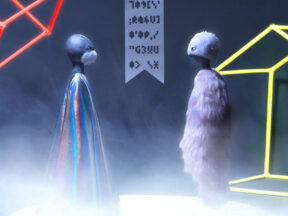
Is it a film or a game? Interactivity and non-linear storytelling have been more the realm of gaming than short filmmaking, but the two fields are slowly merging. In the coming years, interactivity promises to become a valuable tool in the short filmmaker’s arsenal. Bla Bla created for the NFB by Montreal director Vincent Morisset is one of the more ambitious and successful interactive film experiments I’ve seen. The press release below contains lots of details about what it’s all about. But first, be sure to spend some time exploring the film itself by going HERE.

Vincent Morisset’s BLA BLA is an interactive tale that explores the fundamental principles of human communication. The viewer makes the story possible: without him or her, the characters remain inert, waiting for the next interaction. The spectator clicks, plays and searches through the simple, uncluttered scenes, truly driving the experience.

Each of the six chapters in the story depicts a different aspect of communication: learning a language, making small talk, expressing emotions, etc. Rich in opportunities for discovery, BLA BLA illustrates these concepts through endearing yet perplexing characters. The figures were designed by Caroline Robert using a variety of techniques, both traditional and hi-tech.

“BLA BLA uses xerography, drawing on paper, ActionScript-generated animations, puppet stop-motion combined with real-time 3D mapping, etc.,” Morisset explains. “I am inspired by projects that feel free aesthetically. I wanted BLA BLA to feel hand-made, imperfect, fragile, so we forget about the technology.”

The music as well as the characters’ speech were fragmented into tiny clips and then scored through programming. Composer Philippe Lambert designed a progressive soundscape that uses “controlled randomness.” Morisset relied on the skills of software developer Édouard Lanctôt-Benoît for the programming of BLA BLA.

The work stands apart in its emphasis on achieving an emotional response in the viewer/actor. “I wanted to create moods and generate emotions through an interactive piece,” Morriset says. “It’s quite hard to do dramatic crescendos on a website… I thought it would be an interesting challenge.”

As part of the creative process for BLA BLA, Morisset extensively researched interactive narrative. Seeking a filmmaking language specific to the online realm, he defined a new grammar of non-linear editing. Through the very format of the work, he therefore questions the challenges of communication and of telling a story in which the spectator is a participant: “The project in itself explores the grammar of a new medium,” he says.

BLA BLA thus offers a new vision of communication in the wider sense, of how our natural behaviours and interactions with others play out in the world. “The relation between the user and the film is part of the message,” Morriset explains. “We wrote and created it based on universal stuff: the social nature of humans, our fear of the unknown, the desire for appropriation and freedom, and paradoxically the love of being taken by the hand.”

Morisset has been exploring the narrative potential of interactive art for twelve years now. His pioneering work in the field has included several collaborations with the group Arcade Fire, including “be oNline B”, widely considered the first interactive music video, and MIROIR NOIR, a documentary portrait of the band. With the support of the NFB, he now offers us BLA BLA, a one-of-a-kind experience that further refines his hallmark: re-imagining “once upon a time” for the digital age.

CREDITS
Direction, Animation and Compositing
Vincent Morisset

Sound, Music and Voice
Philippe Lambert

Programming and Technology
Édouard Lanctôt-Benoit

Visual Design and Animation
Caroline Robert

Puppet Armature Design
Jean-François Lévesque

Rotoscopy
Vincent Lambert

Photography
Minelly Kamemura

Additional Prototype Programming
Mathieu Campagna

Prototype 3D Modelling and Animation
Joshua Sherrett
Jonathan Fleming-Bock

(Thanks, J. J. Sedelmaier)

Bla Bla

November 3, 2011 1:29 pm


Saul Bass book

Resistance is futile! Pat Kirkham’s long-overdue book about graphic design legend and motion picture title innovator Saul Bass is finally out. Saul Bass: A Life in Film and Design is an epic 440 pages and includes nearly 1,500 illustrations. Designed by Bass’s daugher Jennifer Bass, the book is quite unbelievably the first major American retrospective of Bass’s work.

Bass had a long and infuential career in graphic and corporate identity design, but today he is perhaps best remembered for his groundbreaking motion picture titles, of which there are 70 examples in the book. To create those, Bass collaborated with many animators throughout his career, including Bill Melendez (It’s a Mad Mad Mad Mad World titles), Bill Hurtz (Around the World in 80 Days end titles), Fred Crippen (The Sale of Manhattan and Why Man Creates) and John Whitney, Sr. (Vertigo titles).

The book is $45 on Amazon.

Saul Bass book

Saul Bass book

Saul Bass book

Saul Bass book

Saul Bass book

Saul Bass book

November 2, 2011 4:34 am


Dover Boys

As much as I love classic animation, I rarely (if ever) enjoy modern-day revivals and tributes to classic animation styles. I shudder every time I see a Tex Avery “take” imitation, a stylized “cartoon modern” character design, a Milt Kahl-ish performance, or yet another rubber-hosed Fleischer-style animated piece. Of course, building on these elements to achieve something new is fantastic, but too many animators view the act of recreating and referencing past styles as an accomplishment in itself. It’s an artistic dead end, explains animator and teacher Mark Mayerson in this must-read blog post. He analyzes a relatively recent Tom & Jerry short The Karate Guard to illustrate his point. It all boils down to this, he says:

Creative works are not only the product of people, they’re also the products of a time and place. As the world keeps changing, it is impossible to recreate something from the past. While artists often wish to duplicate what they love, they can only approximate it. Paradoxically, the closer they get to it, the more they’ve succeeded in doing nothing more than an good imitation. And since the originals are everywhere to begin with, is an imitation necessary?